
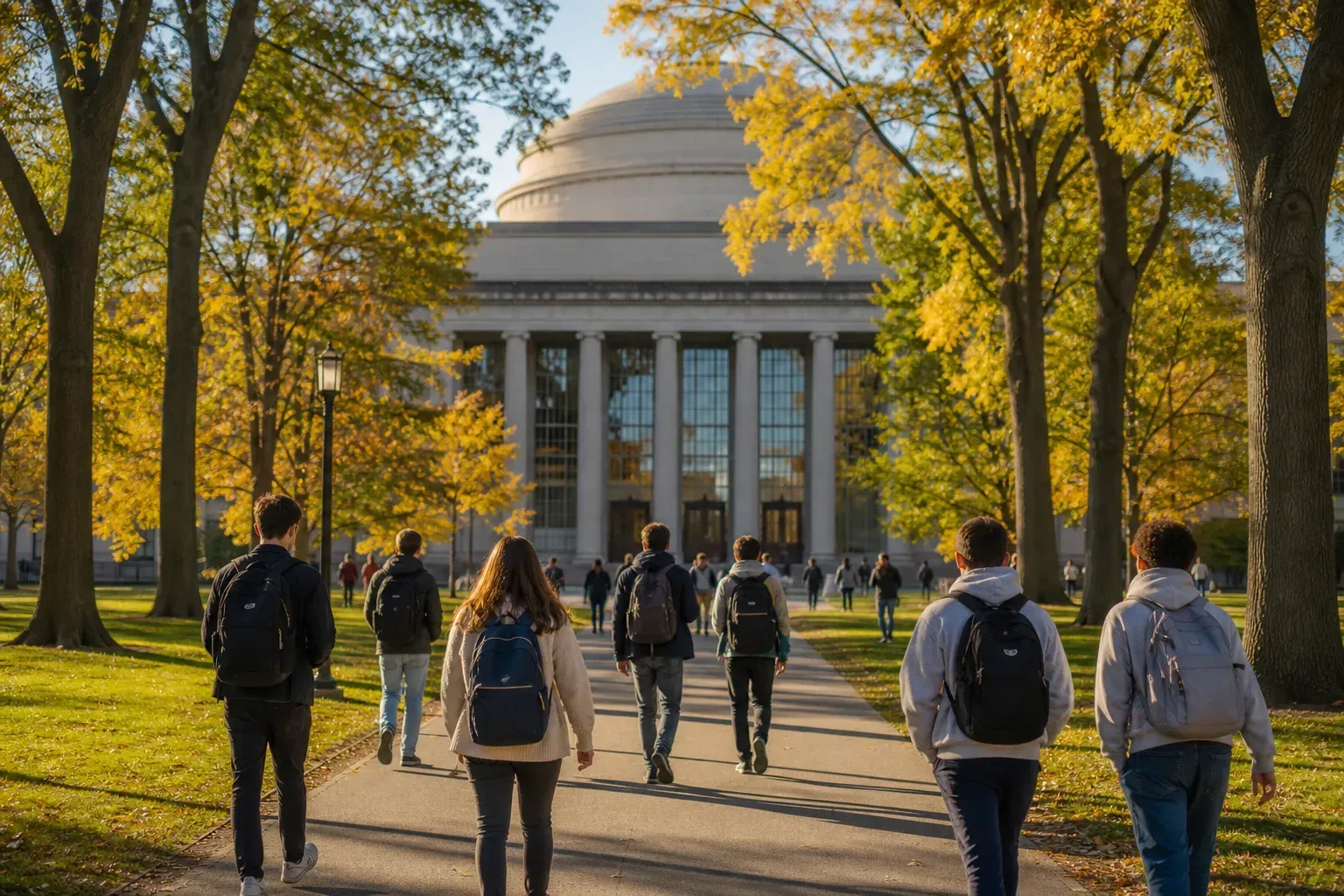
MIT: A Dream Destination for STEM Students, Hack Culture, and IAP
If you have competed in USACO Platinum, scored above 120 on the AMC 12, or won an award at ISEF, MIT is probably the school you dream about in your sleep. Ranked #2 nationally by US News and #1 in the world by QS for more than a decade, MIT’s 4% admission rate is not a contest of “application tricks.” It is a contest of “what have you actually built that could change the world?”
MIT is not simply “the STEM version of Harvard.” It is a civilization of its own, with its own Course Numbering system, its own IAP activity month, its own Hack traditions, and even its own academic philosophy that refuses to rank students by GPA. While other elite universities are still comparing themselves through rankings, MIT students are soldering circuit boards in basements and pulling three all-nighters in a row for a demo.
1. Basic Information
| Item | Details |
|---|---|
| Founded | 1861 |
| Location | Cambridge, Massachusetts (across the river from Boston) |
| Campus | 168 acres (along the north bank of the Charles River) |
| Undergraduates | ~4,600 |
| Graduate students | ~7,300 |
| Student-faculty ratio | 1:3 (one of the lowest in the U.S.) |
| Motto | Mens et Manus (Mind and Hand) |
2. World Rankings
| Ranking | Position |
|---|---|
| US News National Universities 2025 | #2 |
| QS World 2025 | #1 (for many consecutive years) |
| THE World 2025 | #2 |
| US News Engineering (Undergraduate) | #1 |
| US News Computer Science | #1 |
| US News Economics | #1 (tied) |
| US News Mathematics | #1 |
3. Admissions Data (Class of 2028)
| Metric | Value |
|---|---|
| Applicants | ~28,000 |
| Admitted students | ~1,290 |
| Overall admit rate | about 4.5% |
| EA admit rate | ~5.3% |
| RD admit rate | ~4.0% |
| Yield Rate | ~85% |
SAT/ACT Midpoints
| Test | 25th percentile | Median | 75th percentile |
|---|---|---|---|
| SAT | 1530 | 1560 | 1580 |
| ACT | 34 | 35 | 36 |
MIT is a Test-Required school (it has reinstated the SAT/ACT requirement), a relatively clear stance among Top 10 universities.
International Students
- International students make up about 11%
- Students come from 80+ countries
- Around 5-10 students from Taiwan are admitted each year (including ABC students and dual citizens)
4. Tuition and Financial Aid
2024-2025 Costs
| Item | Amount |
|---|---|
| Tuition | USD $61,990 |
| Housing | USD $12,470 |
| Food | USD $7,860 |
| Personal + Misc | USD $4,400 |
| Total | USD $86,720+ |
Need-Based Aid
- Family income < $100,000: full cost covered (tuition, housing, and meals fully covered)
- Family income < $200,000: tuition fully covered
- Need-Blind for international students: MIT is one of the few U.S. schools that is need-blind for international students (alongside Harvard, Princeton, Yale, and Amherst)
- No-Loan Policy: all financial aid is given as grants, with no loans required
- Average Aid: USD $66,000/year
- About 60% of undergraduates receive Need-Based Aid
5. Academic Structure / Signature Programs
Course Numbering System (Unique to MIT)
MIT students do not say, “I study Computer Science.” They say, “I’m in Course 6.” Every department has a number:
| Course # | Department |
|---|---|
| 1 | Civil & Environmental Engineering |
| 2 | Mechanical Engineering |
| 3 | Materials Science & Engineering |
| 6 | Electrical Engineering & Computer Science (EECS, the largest department) |
| 7 | Biology |
| 8 | Physics |
| 9 | Brain and Cognitive Sciences |
| 14 | Economics |
| 15 | Management (Sloan) |
| 16 | Aerospace |
| 18 | Mathematics |
Top 5 Popular Majors:
- Course 6 (EECS) - nearly 40% of students
- Course 18 (Math)
- Course 6-7 (Computational Biology)
- Course 8 (Physics)
- Course 16 (AeroAstro)
Signature Systems
- UROP (Undergraduate Research Opportunities Program): more than 90% of undergraduates participate in UROP, working on real research with professors as early as freshman year
- IAP (Independent Activities Period): a four-week free activity period every January, when students can take mini-courses, work on projects, or go abroad
- MISTI: MIT International Science and Technology Initiatives, for overseas internships
- First-Year Pass/No Record: first-semester freshmen do not receive letter grades, giving students time to adjust
General Education Structure
- General Institute Requirements (GIRs): physics, chemistry, biology, calculus, humanities, and social sciences
- HASS (Humanities, Arts, Social Sciences): 8 required subjects
- Every MIT student, regardless of major, must know the basics of calculus, physics, and chemistry
6. Campus Culture / School Personality
MIT’s campus culture can be summarized in three words: Hardcore, Quirky, Collaborative. Students use the firehose metaphor to describe MIT’s academic workload. You are not drinking water; you are being blasted by it. But contrary to outside assumptions, MIT is not a place of cutthroat internal competition. Students are comrades who stay up all night solving P-sets (problem sets) together.
Hack Culture (MIT’s Most Distinctive Tradition)
A Hack is not a cyberattack. It is an elaborate anonymous prank created by MIT students. Historic examples include:
- Placing a police car (a replica) on top of the Great Dome (1994)
- Projecting R2-D2 onto the Great Dome (2010)
- Secretly replacing all campus signs with MIT logos during Caltech’s admitted students open house
- A Hack must be harmless, clever, and reversible - those are the rules
Greek Life
- About 25% of students join fraternities or sororities
- The culture is very different from Southern schools and is mostly social and residential in function
Athletics Culture
- NCAA Division III (no athletic scholarships)
- Yet MIT has 33 varsity teams, one of the highest numbers in the country
- Signature sports: Crew (rowing), Sailing, Pistol Shooting
7. Location / Campus Environment
Urban Positioning
MIT is located in Cambridge, with Boston across the Charles River and Harvard nearby. The Kendall/MIT stop on the Red Line connects directly to campus. Cambridge has one of the world’s highest concentrations of biotech, AI, and venture capital. Kendall Square is known as “the most innovative square mile on the planet.”
Climate
- Winter: -5°C to 5°C, frequent snow, and the Charles River may freeze
- Summer: 25-30°C
- Autumn foliage and spring cherry blossoms
Campus Landmarks
- Great Dome (modeled after the Roman Pantheon)
- Killian Court
- Stata Center (Frank Gehry’s tilted, unconventional building)
- Media Lab
- Infinite Corridor (an 830-foot-long corridor where “MIThenge” sunsets align at certain times of year)
8. Research and Resources
Libraries
- 5 main libraries, with a total collection of more than 3 million volumes
- Hayden Library, open 24 hours
Famous Labs / Research Centers
- MIT Media Lab: a hub of interdisciplinary innovation that helped produce Scratch, One Laptop per Child, and Lego Mindstorms
- CSAIL (Computer Science and AI Lab): one of the world’s largest computer science research institutions
- Lincoln Laboratory: a Department of Defense FFRDC focused on radar, space, and semiconductors
- Whitehead Institute: genomics and biomedicine
- Plasma Science and Fusion Center: nuclear fusion
- McGovern Institute for Brain Research
9. Notable Alumni
- Tech entrepreneurship: Buzz Aldrin (moon-landing astronaut), Drew Houston (founder of Dropbox), Robin Li (founder of Baidu), Salman Khan (founder of Khan Academy), I.M. Pei (master architect)
- Finance / Business: Carly Fiorina, William Hewlett (co-founder of HP)
- Academia / Nobel Prizes: MIT alumni and faculty have collectively received 100+ Nobel Prizes, including Richard Feynman (undergraduate)
- Politics: Benjamin Netanyahu (Prime Minister of Israel)
- Entertainment: Brit Marling
10. MIT Fun Facts
- The Brass Rat: MIT’s graduation ring is called the “Brass Rat” (because the mascot is a beaver), and each class designs its own version
- Tim the Beaver: the mascot is a beaver because the beaver is “Nature’s engineer”
- MIT does not have a fraternity with a Greek name: all fraternities use standard Greek-letter names, but Number One House, whose name begins with “No,” is one of the school’s most eccentric residential traditions
- You can take a course “for free” in your eighth semester: because of the general education design, many students use their final semester to take a class “for themselves” (philosophy, painting, music theory)
- The school once moved its entire campus: in 1916, MIT moved from Boston’s Back Bay to Cambridge in an event called The Move, with students marching across Harvard Bridge carrying the MIT seal
11. Typical Admitted Student Profile
- GPA Unweighted ~3.97+
- SAT 1530+ or ACT 35+
- 12+ AP courses / full IB HL load (mostly STEM)
- The spike must be real: USACO Platinum / Gold, AMC 12 -> AIME qualification, national Olympiad team (IMO/IPhO/IChO/IBO), ISEF placement, or an independent open-source project with 1,000+ stars
- Essays demonstrate the Mens et Manus spirit - not just thinking, but building
- The MIT Maker Portfolio encourages applicants to submit real things they have made (programs, machines, papers)
- Recommendation letters can explain that “this student is not just smart; they cannot stop building”
MIT does not admit the “brilliant but arrogant” type. It admits the student who is brilliant, willing to get their hands dirty, and able to collaborate.
12. What Kind of Student Is a Good Fit?
✓ Good fit:
- Students who genuinely love math, physics, CS, or engineering
- People who can be blasted by the firehose for four years and still feel excited
- Makers who enjoy hands-on building rather than empty talk
- Practical engineers who want to build startups and change the world
- Students who feel excited, not annoyed, by Hack culture
- International students from limited-income families who need generous financial aid
✗ Not necessarily a good fit:
- Pure humanities or social science students (MIT has these fields, but they are not its core strength)
- Students who want a calm, low-pressure college life
- Students who dream of Southern Greek Life or a party-campus environment
- Students interested in Pre-Med if hardcore STEM is not their thing
- Students who are afraid of feeling, “I may not be the smartest person here”
Conclusion
MIT will not make you “smarter than you were before MIT.” You have to be smart already to get in. What MIT does is push your intelligence to its limit and then another 30% beyond it, forcing you to discover what you are capable of building.
If you have done USACO, AMC, or ISEF, and your dream is to change the world through engineering practice, MIT is the best place on Earth. If you only have a perfect SAT score but have not genuinely “built anything,” MIT may actually screen you out as “too typical” an applicant. That is the real reason Harvard might take you while MIT might not.
Further Reading
Where does this school belong on your list?
Whether a school is a reach, a match or a safety depends on your transcript, your scores and how that school actually admits international applicants. In one free consultation we place it inside a complete reach/match/safety list rather than judging it on its own.
More in This Topic
Harvard University: America’s Oldest University, Final Clubs, and a Lifetime Identity Card
Harvard is more than rankings and brand prestige. Its real value lies in a lifelong network that continues to open doors decades after admission.
Yale University: The Ivy League's Humanistic Heart, Residential Colleges, Drama, and Political Legacy
Yale University is the Ivy League school most reminiscent of Hogwarts, with 14 residential colleges, a legendary drama tradition, and deep roots in American politics, law, and the humanities.
Duke University: Southern Ivy, Trinity + Pratt Dual Colleges, Basketball Culture
Duke is one of the most "American college experience" schools in the Top 10: elite academics, blue-and-white basketball energy, Greek Life, Southern sunshine, Trinity + Pratt flexibility, and a meaningful ED advantage.
Johns Hopkins University: America’s First Research University, King of BME, and a Medical Powerhouse
Johns Hopkins University is America’s first research university and one of the strongest global pipelines for pre-med, biomedical engineering, and public health.