
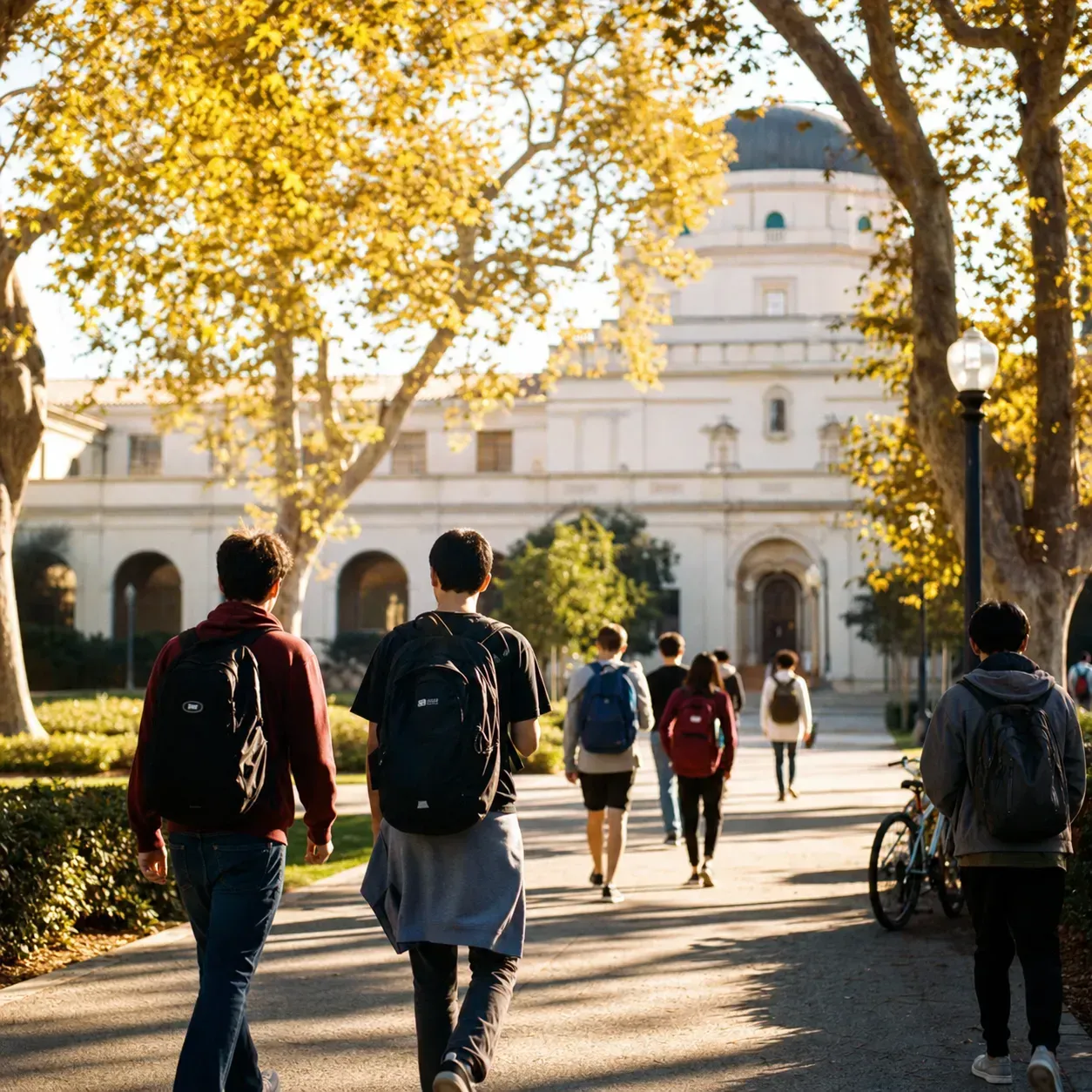
California Institute of Technology: America's Most Hardcore STEM University, Smallest Scale, Honor Code
US News ranks it tied for sixth nationally, but for pure scientists, Caltech will always be “the world’s most hardcore STEM university.” Its undergraduate class has only about 235 students, smaller than a single Taiwanese high school. Those 235 students could fill five office buildings named after Nobel laureates; they may co-author Nature papers with professors as sophomores; they may calculate the trajectory for JPL’s next mission at age 18.
Caltech is not “a smaller West Coast version of MIT.” That description undersells it. MIT finds geniuses among 4,600 students; Caltech admits only geniuses among 985. Every admitted student is treated by Caltech as a serious future Nobel Prize candidate in training.
1. Basic Information
| Item | Details |
|---|---|
| Founded | 1891 |
| Location | Pasadena, California (Los Angeles suburb) |
| Campus | 124 acres |
| Undergraduates | ~985 (one of the smallest research universities in the United States) |
| Graduate students | ~1,400 |
| Student-faculty ratio | 1:3 (among the lowest in the United States) |
| Motto | The truth shall make you free |
2. World Rankings
| Ranking | Position |
|---|---|
| US News National Universities 2025 | #6 (tied) |
| QS World 2025 | #15 |
| THE World 2025 | #7 |
| US News Physics | #1 |
| US News Earth Sciences | #1 |
| US News Aerospace Engineering | #1 |
| US News Geology | #1 |
3. Admissions Data (Class of 2028)
| Metric | Value |
|---|---|
| Applicants | ~13,500 |
| Admitted students | ~420 |
| Overall acceptance rate | about 3.1% |
| EA acceptance rate | ~5% |
| RD acceptance rate | ~2.7% |
| Yield Rate | ~58% |
SAT/ACT Median Scores
| Test | 25th percentile | Median | 75th percentile |
|---|---|---|---|
| SAT | 1530 | 1550 | 1570 |
| ACT | 35 | 35 | 36 |
Caltech reinstated Test-Required admissions in 2024, becoming the second top university after MIT to clearly bring back mandatory SAT/ACT scores.
International Students
- International students make up about 9%
- Representing 30+ countries
- About 1-3 students from Taiwan are admitted each year (a reflection of Caltech’s small size)
4. Tuition and Financial Aid
2024-2025 Cost of Attendance
| Item | Amount |
|---|---|
| Tuition | USD $63,255 |
| Housing | USD $11,640 |
| Food | USD $8,070 |
| Personal + Misc | USD $4,890 |
| Total | USD $87,855+ |
Need-Based Aid
- Family annual income < $100,000: full tuition covered
- International students: Need-Aware (unlike HYPSM! This is one of Caltech’s weaker points)
- Average Aid: USD $58,000/year
- About 50% of undergraduates receive Need-Based Aid
Important distinction: Caltech is Need-Aware for international students, meaning that needing aid can reduce the chance of admission. This is the biggest difference between Caltech and MIT. For Taiwanese families who need financial aid, MIT/Harvard/Princeton/Yale/Stanford may actually be safer choices than Caltech.
5. Academic Structure / Signature Programs
Undergraduate Majors
- 28 Options in total (Caltech calls majors “Options”)
- Top 5 Popular Options:
- Computer Science
- Mechanical Engineering
- Electrical Engineering
- Physics
- Chemical Engineering
Signature Systems
- Core Curriculum: All students, regardless of major, must complete “5 terms of physics + 5 terms of mathematics + 2 terms of chemistry + 1 term of biology.” This is the foundation of Caltech: if you come here, you are here to master fundamental science
- SURF (Summer Undergraduate Research Fellowships): A 10-week paid summer research program; more than 50% of undergraduates participate
- JPL Partnership: Caltech manages NASA’s Jet Propulsion Laboratory, allowing students to take part in real space missions
- Honor Code: An academic integrity system where final exams are often take-home and unproctored
General Education Structure
- HSS (Humanities & Social Sciences) requires 12 credits, stricter than MIT
- General education is not “decoration”; Caltech genuinely expects scientists to write and read well
6. Campus Culture / Institutional Personality
Caltech’s personality can be summed up in one sentence: “We do not pretend this place is easy.” The academic pressure is among the highest in the United States, but compared with MIT, Caltech is more “pure,” less commercialized, and less focused on startups. Students here aspire to become professors, Nobel laureates, and space scientists, not founders.
Houses (Replacing Greek Life)
Caltech has no fraternities. Instead, it has 8 Houses (Avery, Blacker, Dabney, Fleming, Lloyd, Page, Ricketts, Ruddock). Each House has its own personality, traditions, and odd rituals. During freshman “Rotation Week,” students try dinner at each House before a two-way matching process.
Prank Culture (and MIT Rivalry)
Caltech and MIT have what may be “America’s smartest prank war.” Historic examples include:
- 1984 Rose Bowl: Caltech students hacked the scoreboard and changed it to Caltech vs MIT
- 2005: MIT stole Caltech’s Fleming Cannon and transported it back to Cambridge
- 2006: Caltech students secretly replaced all the signs on MIT’s campus during campus preview days with Caltech signs
Athletics Culture
- NCAA Division III, no athletic scholarships
- Varsity teams exist, but no one cares; this is part of Caltech culture
- Signature sports: water polo, swimming
7. Location / Campus Environment
City Context
Pasadena is a suburb in the Los Angeles metropolitan area, about 30 minutes from downtown LA. Its atmosphere is “quiet, affluent, and academic,” completely different from the noise of Hollywood. From campus, students can walk to the restaurant streets of Old Pasadena and the Norton Simon Museum.
Climate
- One of the most comfortable climates in the United States
- Winter: 10-18°C, very little rain
- Summer: 25-30°C, dry
- No real sense of four seasons; it feels like spring all year
Campus Landmarks
- Beckman Auditorium (main venue for musical performances)
- Millikan Library (11 stories tall)
- Athenaeum (student + faculty dining hall, grand like a European club)
- Cahill Center for Astronomy and Astrophysics
8. Research and Resources
Libraries
- 6 libraries with a total collection of 750,000 volumes (small in scale, extremely dense in quality)
Notable Laboratories / Research Centers
- JPL (Jet Propulsion Laboratory): Caltech manages this NASA laboratory; the Mars rovers and Cassini mission came from here
- LIGO (Laser Interferometer Gravitational-Wave Observatory): 2017 Nobel Prize, gravitational wave detection
- Kavli Nanoscience Institute
- Resnick Sustainability Institute
- Tianqiao and Chrissy Chen Institute for Neuroscience
9. Notable Alumni
- Academia / Nobel Prizes: 46 Nobel laureates in total (highest per capita in the world), including Richard Feynman (faculty), Linus Pauling, Kip Thorne (LIGO), Frances Arnold
- Technology entrepreneurship: Gordon Moore (Intel co-founder, proposed Moore’s Law), Stewart Brand
- Space: Many JPL and NASA scientists and space mission leaders
- Film and entertainment: Frank Capra (director of It’s a Wonderful Life)
Caltech alumni have a higher Nobel Prize rate per capita than MIT, Harvard, and Stanford. That is pure mathematics.
10. Caltech Fun Facts
- Caltech’s mascot is the beaver: same as MIT (“Nature’s engineer”), one of the reasons the two schools keep arguing.
- Caltech has no Greek Life: the only Top 10 university in the United States with no fraternities or sororities at all.
- Pranks are part of the record: seriously; Caltech has official records and exhibits of alumni pranks.
- The Honor Code is sacred: exams are often take-home and unproctored, and students voluntarily uphold honesty.
- Reference point for The Big Bang Theory: Sheldon Cooper’s Caltech position in the show is based on the real campus.
11. Typical Admitted Student Profile
- GPA Unweighted ~3.97+
- SAT 1530+ or ACT 35+
- 12+ AP courses (heavily STEM-focused)
- Spike must be genuinely hardcore academic: Olympiad national team, PROMYS / Ross / RSI summer research, first-author Nature paper (rare, but it does happen)
- Essays show pure love for fundamental science, not “I want to build products,” but “I want to understand the universe”
- Recommendation letters come from research professors / mentors, not just high school teachers
- Caltech does not care about leadership / community service; it only cares whether you are truly “obsessed with science”
12. What Kind of Student Is Caltech Right For?
✓ Good fit:
- Students who truly love physics, mathematics, chemistry, or biology
- Students who want to do fundamental research and pursue a PhD
- Students who enjoy an extremely small community and knowing everyone
- Students who do not care about Greek Life / athletics / party culture
- Students who want to do research at the level of space, quantum science, or gravitational waves
- Students who want to brainstorm with the strongest minds in the world
✗ Not necessarily a good fit:
- Purely applied CS students who only want to go into Silicon Valley startups (Stanford and MIT are better fits)
- Students planning pre-med before medical school (Caltech has no med school, and pre-med advising/coursework is not highly developed)
- Students longing for “college life”: parties, dating, social scenes (Caltech is monastery-level ascetic)
- Students afraid of academic pressure (this is one of the most hardcore undergraduate environments on Earth)
- Families needing generous international student aid (Caltech is Need-Aware)
Conclusion
Caltech is not for students who say, “I also like science.” It is for students who say, “I do not want to do anything except science.”
The question Taiwanese parents are most often confused about is: “Caltech or MIT?” My judgment is:
- If you want to build startups, build products, and go to Silicon Valley: MIT
- If you want to do true fundamental science, win a Nobel Prize, and become a professor: Caltech
Caltech is not a smaller MIT. It is a different choice: the world’s last university that truly only cares about science.
Further Reading
Where does this school belong on your list?
Whether a school is a reach, a match or a safety depends on your transcript, your scores and how that school actually admits international applicants. In one free consultation we place it inside a complete reach/match/safety list rather than judging it on its own.
More in This Topic
Duke University: Southern Ivy, Trinity + Pratt Dual Colleges, Basketball Culture
Duke is one of the most "American college experience" schools in the Top 10: elite academics, blue-and-white basketball energy, Greek Life, Southern sunshine, Trinity + Pratt flexibility, and a meaningful ED advantage.
Johns Hopkins University: America’s First Research University, King of BME, and a Medical Powerhouse
Johns Hopkins University is America’s first research university and one of the strongest global pipelines for pre-med, biomedical engineering, and public health.
Northwestern University: Lakeside Chicago, Medill Journalism, and Flexible Combinations Across 6 Schools
Northwestern is one of the strongest private universities in the Midwest, combining Medill journalism, Kellogg business, McCormick engineering, Bienen music, and rare cross-school flexibility.
University of Pennsylvania: Wharton’s Business Powerhouse, the Most Practical Ivy, and a Major ED Advantage
UPenn is the Ivy League’s most practical, business-oriented university, anchored by Wharton, dual-degree pathways, an urban Philadelphia campus, and one of the strongest Early Decision advantages among top schools.