
Dartmouth College: D-Plan, the Smallest Ivy, and Outdoor Culture
Ranked #15 nationally by US News, with only 4,500 undergraduates and a campus set in a rural New Hampshire valley, Dartmouth is the smallest, most traditional, and most liberal arts college-like member of the Ivy League. It even insists on calling itself a “College” rather than a “University,” despite having graduate schools.
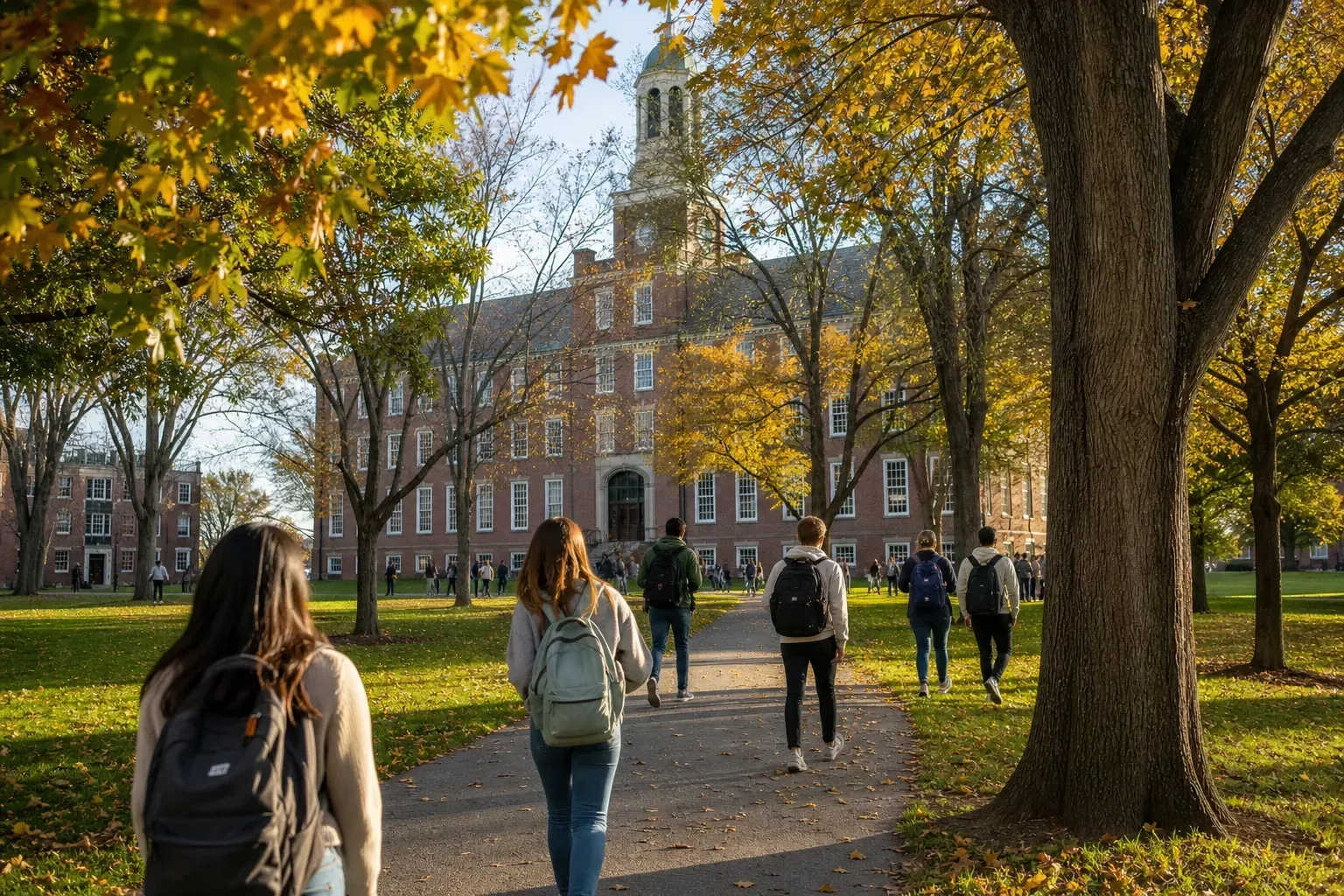
In one sentence, Dartmouth is: “the refined, concentrated version of the Ivy League.” You will not find Columbia’s urban rush here, nor Cornell’s vast campus scale. Instead, you will find a small town surrounded by mountains and forests, where students wear LL Bean and Patagonia, ski after class, row in the summer, and sing the school song around a winter bonfire. That image has barely changed in 250 years.
1. Basic Information
| Item | Details |
|---|---|
| Founded | 1769 (ninth-oldest in the United States) |
| Location | Hanover, New Hampshire (2 hours northwest of Boston by car) |
| Campus | About 269 acres (+ 27,000 acres of forestland) |
| Undergraduates | ~4,500 (smallest in the Ivy League) |
| Graduate Students | ~2,200 |
| Student-Faculty Ratio | 1:7 |
| Motto | Vox clamantis in deserto (a voice crying out in the wilderness) |
2. World Rankings
| Ranking | Position |
|---|---|
| US News National Universities 2025 | #15 |
| QS World 2025 | #233 |
| THE World 2025 | #156 |
| US News Economics | Top 10 |
| US News Government | Top 10 |
| Tuck School of Business (MBA) | Top 10 |
Dartmouth’s QS / THE rankings are relatively low for the same reason as Brown’s: the school is small, and its research output cannot be compared with Harvard’s. Taiwanese families should use US News to evaluate Dartmouth; international rankings seriously underestimate it.
3. Admissions Data (Class of 2028)
| Metric | Figure |
|---|---|
| Applicants | ~31,000 |
| Admitted Students | ~1,870 |
| Overall Acceptance Rate | About 6.0% |
| ED Acceptance Rate | ~17% |
| RD Acceptance Rate | ~5% |
| Yield Rate | ~70% |
Dartmouth’s ED acceptance rate is more than three times its RD rate, and its high yield shows that admitted students genuinely want to attend. For students with a firm Dartmouth dream, ED is the must-use strategy.
SAT/ACT Median Scores
| Test | 25th percentile | Median | 75th percentile |
|---|---|---|---|
| SAT | 1490 | 1540 | 1570 |
| ACT | 33 | 34 | 35 |
International Students
- International students make up about 10%
- Students come from 70+ countries
- Around 2-4 students from Taiwan are admitted each year (a relatively small number among Ivy schools)
4. Tuition and Financial Aid
2024-2025 Costs
| Item | Amount |
|---|---|
| Tuition | USD $66,123 |
| Housing | USD $12,375 |
| Food | USD $7,470 |
| Personal + Misc | USD $4,200 |
| Total | USD $90,170+ |
Need-Based Aid
- Family annual income < $125,000: full tuition covered
- Family annual income < $65,000: tuition + housing + food fully covered
- Need-Blind for international students (new policy since 2022)
- Average Aid: USD $66,000/year
- No-Loan Policy
Dartmouth was the fourth-latest Ivy to adopt “Need-Blind for international students,” joining in 2022. Middle-class Taiwanese families can apply with more confidence.
5. Academic Structure / Signature Programs
D-Plan (Dartmouth’s Signature System)
Dartmouth uses a distinctive quarter system: the year is divided into Fall, Winter, Spring, and Summer terms. Every student must complete 12 terms, including a required summer term in Hanover during junior year, known as “Sophomore Summer.”
Students can independently arrange their “On / Off” terms: each term, they decide whether to take classes. This gives Dartmouth students unusual flexibility. They can intern abroad in the spring, train for skiing in the winter, or work in Silicon Valley during the summer.
Undergraduate Majors
- 60 majors in total
- Top 5 popular majors:
- Economics
- Computer Science
- Government (politics)
- Engineering Sciences
- Biology
Signature Systems
- Thayer School of Engineering: Undergraduates can earn a BE degree through a 5-year program; small but highly refined compared with other Ivy engineering schools
- Tuck School of Business: A Top 10 MBA program nationally, though there is no undergraduate business major
- Geisel School of Medicine: A 4-year medical school
- Foreign Study Programs (FSP): Dartmouth sends one of the highest proportions of students abroad in the Ivy League; students spend about one quarter overseas on average
General Education Structure
Dartmouth has Distribution Requirements, but they are relatively flexible, covering areas such as Arts, Literature, Quantitative, and Science.
6. Campus Culture / School Personality
Dartmouth’s personality is the most traditional, most outdoorsy, and most fraternity-driven in the Ivy League. Students love outdoor adventure, school spirit, and Greek Life. This atmosphere is completely different from Brown / Columbia.
Greek Life (the Core of Dartmouth Culture)
- About 60%+ of students participate in a Fraternity or Sorority, the highest rate in the Ivy League
- It is the center of campus social life, though the school has worked in recent years to reduce alcohol culture
- Famous Frat: Alpha Delta (the inspiration for the film Animal House)
Athletic Culture
- Ivy League conference
- Signature features: Dartmouth Skiway (the school has its own ski area!), Crew, Hockey
- Dartmouth Outing Club (DOC): the largest and oldest student outdoor club in the United States, with 1,500+ members
The “Big Green” Spirit
Students call themselves Big Green. Each year, the Homecoming Bonfire, Winter Carnival, and spring Green Key form the three major traditions that bind Dartmouth students together.
7. Location / Campus Environment
Urban Positioning
Hanover is a small town in New Hampshire with a population of 11,000, even smaller than Princeton. The campus sits in the Connecticut River valley, surrounded by the White Mountains. It is 2 hours from Boston by car and 5 hours from New York. There is no airport, no streets full of Uber cars, and no Trader Joe’s. This is the true “hermit of the Ivy League.”
But that is exactly Dartmouth’s selling point: students spend four years studying, skiing, rowing, and writing papers in the mountains and forests. If this is the vibe you want, Dartmouth is the most fitting place on earth.
Climate
- Winter: -15°C to -3°C, with a 5-month snow season, the coldest in the Ivy League
- Summer: 18-26°C, comfortable
- Autumn foliage is among the most beautiful in New England
Campus Landmarks
- Baker-Berry Library (Baker Tower is the campus landmark)
- Dartmouth Green (central lawn)
- Hopkins Center for the Arts (designed by architect Wallace Harrison, who later designed Lincoln Center)
- Sanborn Library (tea room with free afternoon tea at 4pm every day)
- Dartmouth Skiway
8. Research and Resources
Libraries
- Baker-Berry Library holds 2.5 million volumes
- 8 libraries across campus
- Sanborn Library’s 4pm afternoon tea is a Dartmouth tradition
Notable Labs / Research Centers
- Thayer School of Engineering: interdisciplinary engineering
- Hood Museum of Art: students have access to an on-campus art museum
- Rockefeller Center for Public Policy
- Dickey Center for International Understanding
Dartmouth’s research scale is not as large as Harvard’s / Yale’s, but the density of undergraduate research opportunities is extremely high. With a 1:7 student-faculty ratio, almost every student can find a professor to supervise research.
9. Notable Alumni
- Presidents / Politics: Nelson Rockefeller (former Vice President), Daniel Webster (19th-century U.S. Secretary of State)
- Tech Entrepreneurship: Jeff Bewkes (former Time Warner CEO), John Donahoe (Nike CEO), Andrew Yang (presidential candidate)
- Finance / Business: Henry Paulson (former Secretary of the Treasury), Hank Greenberg (former AIG CEO), Jeffrey Immelt (former GE CEO)
- Academia: Theodor Geisel (Dr. Seuss!), Robert Frost (poet)
- Entertainment / Literature: Mindy Kaling, Shonda Rhimes (Grey’s Anatomy writer), Connie Britton
Dartmouth alumni are known for being extremely loyal to their alma mater. Its alumni giving rate is the highest in the Ivy League because the “four years in the mountains” memory is so powerful.
10. Dartmouth Fun Facts
- Dartmouth is a “College,” not a “University”: it insists on calling itself College despite having graduate schools. This is a cultural marker.
- Homecoming Bonfire: every fall, first-year students run around a giant bonfire. The number of laps equals the year of their Class, such as 28 laps for the Class of 2028.
- The Dartmouth Indian mascot has been retired: in 1974, the “Indian” mascot was formally discontinued out of respect for Native peoples. Today, the school is represented only by the color “Big Green.”
- Dr. Seuss edited a campus publication at Dartmouth: Theodor Geisel was banned from editing the campus publication in college because he violated Prohibition rules. He continued submitting work under the pen name “Seuss,” which became the origin of the Dr. Seuss name.
- Winter Carnival has been a tradition since 1911. Students build huge snow sculptures on Dartmouth Green, including past works that reached 30 meters tall.
11. Typical Admitted Student Profile
- GPA Unweighted ~3.9+
- SAT 1490+ or ACT 33+
- 6-10 AP courses / strong IB
- Spike leans toward well-rounded excellence + outdoor spirit: athletic teams, debate, community service, Eagle Scout, student government
- Essays must show a genuine desire for a small community + outdoor life. Dartmouth does not admit students whose mindset is “I thought all Ivies were basically the same.”
- Recommendation letters should explain your leadership and your ability to “contribute to community”
Dartmouth admits people who will be happy in a small town and are willing to give back to the group.
12. What Kind of Student Is a Good Fit?
✓ Good fit:
- Students who like outdoor activities such as skiing, hiking, and rowing
- Students who want a small, close-knit community and want “every professor to know you”
- Students interested in Greek Life, school spirit, and school traditions
- Students interested in pre-business before business school (Tuck pipeline)
- Students who want engineering with LAC-style teaching (Thayer)
- Students who are not afraid of cold weather, small towns, or being away from major cities
✗ Not necessarily a good fit:
- Students who dream of big-city life and need diverse cultural stimulation
- Students who dislike Greek Life or strongly dislike drinking culture
- Students who want the resources of a large research university (Cornell may be a better fit)
- Students who fear cold, snow, or long dark nights
- Students who want quick access to internships (Hanover does not have Wall Street)
Conclusion
Dartmouth is the Ivy League school with the strongest liberal arts college temperament. Its soul is closer to Williams and Amherst than to Harvard or Columbia. If your dream is to “disappear into a big city after entering college,” Dartmouth is the wrong choice. If your dream is to “spend four years studying in the mountains and forests, becoming lifelong friends with a close group of people,” Dartmouth is the most romantic option in the Ivy League.
The sentence Dartmouth alumni say most often is: “I’d choose Dartmouth again, every single time.” This sentiment is rare among alumni of other Ivy schools. Harvard alumni may say “Harvard changed my life,” Princeton alumni may say “I learned a lot,” but Dartmouth alumni say, “Those were the happiest four years of my life.” If you long for that kind of happiness, Dartmouth is waiting for you.
Further Reading
Where does this school belong on your list?
Whether a school is a reach, a match or a safety depends on your transcript, your scores and how that school actually admits international applicants. In one free consultation we place it inside a complete reach/match/safety list rather than judging it on its own.
More in This Topic
UCLA: A Public Ivy, LA Campus, and Powerhouse in Athletics and the Arts
UCLA is a Top 15 public university with unmatched resources, an LA location, elite athletics, and explosive application volume. For international students, however, UCLA is essentially self-funded, with annual costs around USD $70,000+ and almost no need-based aid.
UC Berkeley: Public Ivy, EECS/Haas Powerhouse, Stanford’s Archrival
A complete UC Berkeley profile: 11% acceptance rate, EECS ranked Top 2 in the U.S., and Haas Business School in the Top 10. Why is Berkeley considered the leading “Public Ivy”? How should Taiwanese families evaluate this public flagship known for academic intensity and a rebellious spirit?
Rice University: Residential Colleges, Houston Campus, and the Ivy of the South
Rice is one of the most overlooked Top 20 universities among Taiwanese families. With Ivy-level academics, a 1:6 student-faculty ratio, 11 Residential Colleges, and exceptional access to Houston's medical and energy industries, it offers a rare blend of academic rigor, community, and value.
University of Notre Dame: Catholic Tradition, Fighting Irish, and the Most Devout Top 20 University
Notre Dame is the only Catholic university in the Top 20 and one of the most alumni-loyal schools in the United States. From Mendoza Business to Fighting Irish football and mandatory theology courses, its defining question is not only academics, but fit.