
Brown University: Open Curriculum, Self-Directed Learning, and the Freest Ivy
Ranked tied for #13 nationally by US News, and the Ivy League school that feels least like an Ivy: Brown has no Core Curriculum, no mandatory distribution requirements, and allows students to take courses Pass/No Credit throughout their studies. While other Ivy League schools try to shape students into a certain kind of person, Brown says the opposite: “You decide what you want to become.”
That freedom is real, not marketing language. Brown students usually take 4 courses per semester, and they can choose Philosophy + Painting + Linguistics + Neuroscience if they want. No one will stop them. But the cost of that freedom is also real: Brown admits students who do not need a fixed framework in the first place.
1. Basic Information
| Item | Details |
|---|---|
| Founded | 1764 (the seventh-oldest university in the United States) |
| Location | Providence, Rhode Island (1 hour south of Boston by car) |
| Campus | About 143 acres |
| Undergraduates | ~7,200 |
| Graduate Students | ~3,000 |
| Student-Faculty Ratio | 1:6 |
| Motto | In Deo Speramus (In God We Hope) |
2. World Rankings
| Ranking | Position |
|---|---|
| US News National Universities 2025 | #13 |
| QS World 2025 | #64 |
| THE World 2025 | #61 |
| US News Computer Science | Top 20 |
| US News English | Top 10 |
| US News Public Health | Top 10 |
Note: Brown’s QS / THE international rankings are relatively lower because Brown is small and does not produce research at the scale of Harvard or MIT. US News is the fairer lens for evaluating Brown.
3. Admissions Data (Class of 2028)
| Metric | Value |
|---|---|
| Applicants | ~48,900 |
| Admitted Students | ~2,560 |
| Overall Acceptance Rate | About 5.2% |
| ED Acceptance Rate | ~14% |
| RD Acceptance Rate | ~3.8% |
| Yield Rate | ~67% |
Brown’s ED acceptance rate is about 4 times its RD acceptance rate, and its high yield shows that students genuinely want to attend. If Brown is your #1 choice, ED is essential.
SAT/ACT Median Scores
| Test | 25th percentile | Median | 75th percentile |
|---|---|---|---|
| SAT | 1500 | 1545 | 1570 |
| ACT | 34 | 35 | 35 |
International Students
- International students make up about 11%
- Students come from 90+ countries
- About 3-6 students from Taiwan are admitted each year
4. Tuition and Financial Aid
2024-2025 Cost of Attendance
| Item | Amount |
|---|---|
| Tuition | USD $68,612 |
| Housing | USD $11,180 |
| Food | USD $7,124 |
| Personal + Misc | USD $4,914 |
| Total | USD $93,000+ |
Need-Based Aid
- Family income < $125,000: full tuition covered
- Family income < $60,000: full tuition + housing + food covered (“Brown Promise”)
- Need-Blind for international students (announced in 2022, effective from the Class of 2029)
- Average aid: USD $66,000/year
- No-Loan Policy
Brown was the latest Ivy to join the “Need-Blind for international students” club, and the commitment is substantial. Note the three-class gap between the announcement and the effective date — students entering before the Class of 2029 are not covered.
5. Academic Structure / Signature Programs
Open Curriculum (Brown’s Soul)
Brown’s defining feature is no core requirements: students only need to complete their concentration requirements + two writing requirements. No Distribution, no Core, no required reading list.
- 80+ Concentrations (Brown’s term for majors)
- Top 5 Popular Concentrations:
- Computer Science
- Economics
- International and Public Affairs
- Biology
- Applied Math
Signature Systems
- Open Curriculum: complete freedom in course selection
- S/NC (Satisfactory / No Credit) option: students can take all courses Pass/No Credit (without recording a GPA), encouraging exploration in new fields
- PLME (Program in Liberal Medical Education): an 8-year combined undergraduate and medical program, the only BS/MD dual admission program in the Ivy League, and extremely difficult to enter
- Brown-RISD Dual Degree: a joint degree with RISD (Rhode Island School of Design), allowing students to earn two degrees in 5 years
- Independent Concentration: students can design their own major, such as Bioethics + Asian Studies + Music Cognition
General Education Structure
None! This is Brown’s biggest difference from the other Ivies. Brown only requires two writing courses (First-Year Writing) and completion of the concentration.
6. Campus Culture / Institutional Personality
Brown is the happiest, freest, and quirkiest Ivy. Students care deeply about activism, art, and entrepreneurship, but in a very “Brown” way: not for prestige, but for passion. This is completely different from Harvard’s “I want to become a future president” or UChicago’s “I want to be crushed by ideas.”
Greek Life Does Not Dominate the Culture
- Greek Life participation is about 10%, relatively low
- Campus organizations are diverse, from the Brown Outing Club to the student newspaper, The Brown Daily Herald
Sports Culture
- Ivy League conference
- Signature sports: men’s and women’s water polo, Crew, Squash
- Brown is not an athletics powerhouse, but the Brown vs Yale tradition remains
Student Personality
“Brunonian” is what Brown students call themselves. The adjectives that fit include quirky, creative, socially-conscious, and anti-establishment. Brown students will not compare GPAs with you, but they may ask what book you have been reading lately.
7. Location / Campus Environment
City Profile
Providence is the capital of Rhode Island, the smallest state in the United States, with a population of 190,000. It is 1 hour from Boston by train and 3 hours from New York. Providence is not as large as Boston or as expensive as New York, but it offers a complete urban life: restaurants, arts districts (RISD is next door), and Federal Hill, the city’s Italian neighborhood. Brown students call Providence the “most underrated college town in the Northeast.”
Climate
- Winter: -3°C to 5°C, with snow, but milder than Boston
- Summer: 25-30°C, relatively dry
- Pleasant spring and fall, with New England foliage
Campus Landmarks
- College Hill (where the campus sits, overlooking Providence)
- John Hay Library
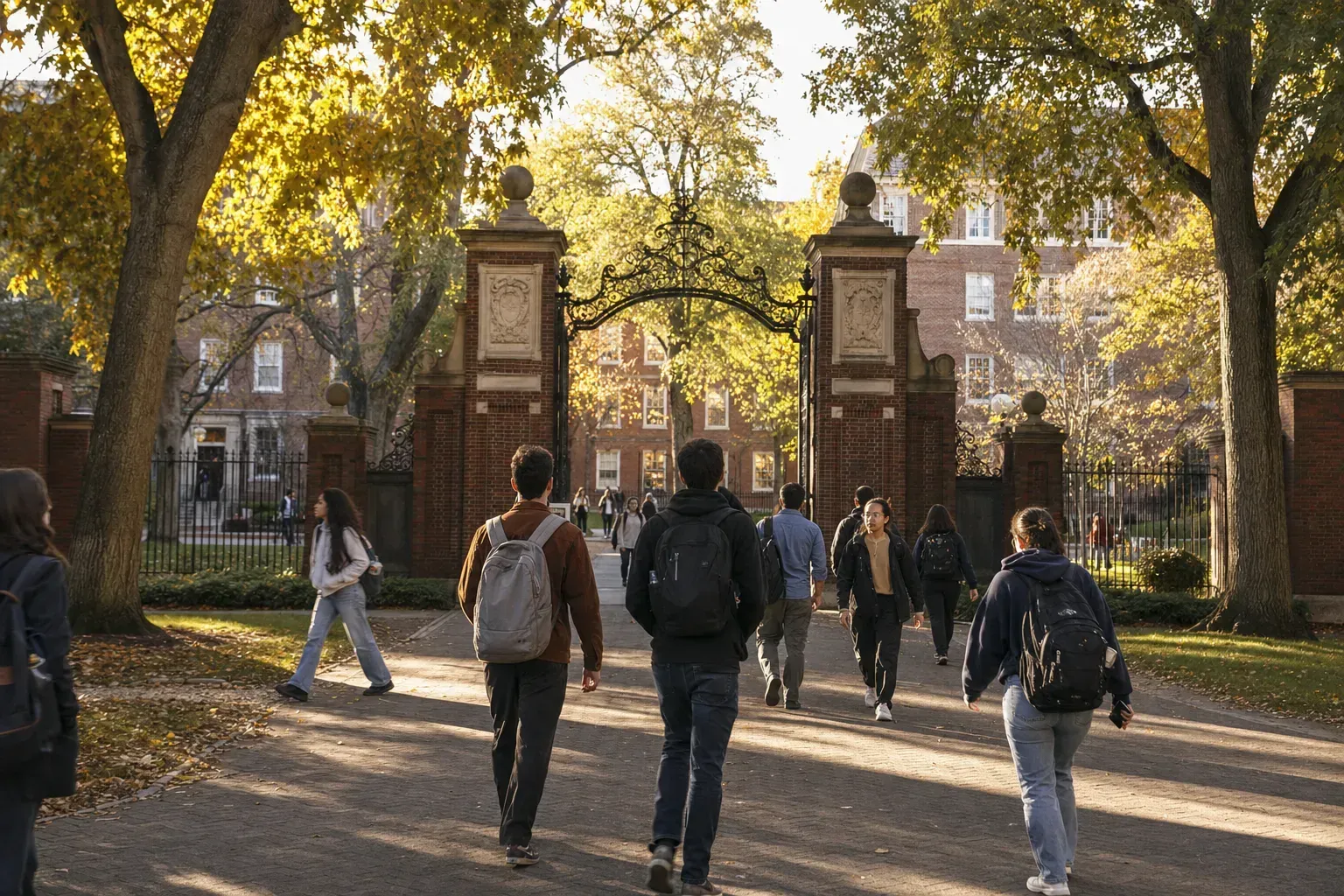
- Van Wickle Gates (the century-old campus gates, opened for graduation)
- The Quiet Green / The Main Green
- Sayles Hall
8. Research and Resources
Libraries
- Rockefeller Library (main library)
- John Hay Library (special collections, including Lincoln materials)
- 6 libraries across campus, with a total collection of 7 million volumes
Notable Labs / Research Centers
- Carney Institute for Brain Science
- Watson Institute for International and Public Affairs
- Brown Institute for Translational Science
- Cogut Institute for the Humanities
Although Brown is small, its humanities and social science research is highly respected within the Ivy League, especially in Slavic Studies and Comparative Literature.
9. Notable Alumni
- Politics / Public Service: John F. Kennedy Jr., Janet Yellen (former Fed Chair), Bobby Jindal
- Technology and Entrepreneurship: Ben Goldhirsh (Good Inc.), Kanye West (briefly attended)
- Finance / Business: Charles Bronfman, Ted Turner (founder of CNN)
- Academia / Nobel Prizes: 8 Nobel laureates in total
- Entertainment / Literature: Emma Watson (lead actress in Harry Potter), John Krasinski (The Office), Daveed Diggs (Hamilton), Tracee Ellis Ross, Masi Oka
Brown has one especially distinctive alumni group: celebrities who came out of Brown. Emma Watson is the most recognizable example. She chose Brown over Cambridge because of the “Open Curriculum.”
10. Brown Fun Facts
- The Van Wickle Gates open for you only twice in your life: once at convocation (opening inward) and once at graduation (opening outward). They remain locked at other times.
- Brown is the second-smallest Ivy (after Dartmouth).
- Pembroke College: Before the 1971 merger, Brown’s women’s college was called Pembroke College. The campus still has a Pembroke Campus area today.
- Brown does not award Latin Honors (cum laude / summa cum laude), because the Open Curriculum + S/NC system itself pushes back against ranking.
- Spring Weekend is Brown’s largest annual music festival. Past performers have included Bob Dylan, Mac Miller, and Lizzo.
11. Typical Admitted Student Profile
- GPA Unweighted ~3.9+
- SAT 1500+ or ACT 34+
- 7-10 AP courses / strong IB
- Spike tends toward creative + socially engaged: original artwork, activist organizations, interdisciplinary research, self-directed projects
- Essays must show “independence + curiosity”: Brown’s supplemental essays directly ask “Why Brown” and why your academic interests are interdisciplinary
- Recommendation letters can explain that “this student seeks out learning opportunities independently”
Brown does not admit “the best test-takers.” It admits the students who are best at finding their own path.
12. What Kind of Student Is a Good Fit?
✓ Good fit:
- Students with strong interests across multiple fields who do not want to be boxed in
- Students who already know how to learn independently and do not need external structure
- Students who want to study humanities before medicine (PLME pathway)
- Students passionate about social issues, art, and design
- Students who want an Ivy League experience that is “happy but not relaxed”
- Students interested in a medium-sized city (Providence is not large, but it is complete)
✗ Not necessarily a good fit:
- Students who need external structure to regulate their learning
- Students who want a clear pre-professional pathway
- Students who crave the intensity of a major city (New York or Chicago would be more suitable)
- Students who want a lively Greek Life scene / major sports culture
- Students who do not yet have their own answer to “why study this?” Brown’s freedom can become a burden
Conclusion
Among Top 15 universities, Brown is the school least suited to being “chosen by parents for their child.” If your child is being pushed into applying to Brown, Brown will swallow them whole. But if your child is the kind of person who says, “I want to decide for myself” and “do not tell me what I have to take,” Brown is the happiest and richest choice in the Ivy League.
The Open Curriculum is not permissiveness. It is trust. Brown believes the students it admits are capable of taking responsibility for themselves, so it gives them full freedom. If you can carry that trust, Brown will help you become yourself. If you cannot, Princeton may actually be steadier. Brown is not for people who say, “I want to attend a famous school.” It is for people who say, “I want to become myself.”
Further Reading
Where does this school belong on your list?
Whether a school is a reach, a match or a safety depends on your transcript, your scores and how that school actually admits international applicants. In one free consultation we place it inside a complete reach/match/safety list rather than judging it on its own.
More in This Topic
Columbia University: Core Curriculum, the Heart of New York City, and the Most Urban Ivy
Columbia University combines the Ivy League’s classic liberal arts tradition with the unmatched resources of New York City. This guide covers admissions data, the Core Curriculum, campus culture, costs, financial aid, and fit for international students and families.
UCLA: A Public Ivy, LA Campus, and Powerhouse in Athletics and the Arts
UCLA is a Top 15 public university with unmatched resources, an LA location, elite athletics, and explosive application volume. For international students, however, UCLA is essentially self-funded, with annual costs around USD $70,000+ and almost no need-based aid.
UC Berkeley: Public Ivy, EECS/Haas Powerhouse, Stanford’s Archrival
A complete UC Berkeley profile: 11% acceptance rate, EECS ranked Top 2 in the U.S., and Haas Business School in the Top 10. Why is Berkeley considered the leading “Public Ivy”? How should Taiwanese families evaluate this public flagship known for academic intensity and a rebellious spirit?
Rice University: Residential Colleges, Houston Campus, and the Ivy of the South
Rice is one of the most overlooked Top 20 universities among Taiwanese families. With Ivy-level academics, a 1:6 student-faculty ratio, 11 Residential Colleges, and exceptional access to Houston's medical and energy industries, it offers a rare blend of academic rigor, community, and value.