
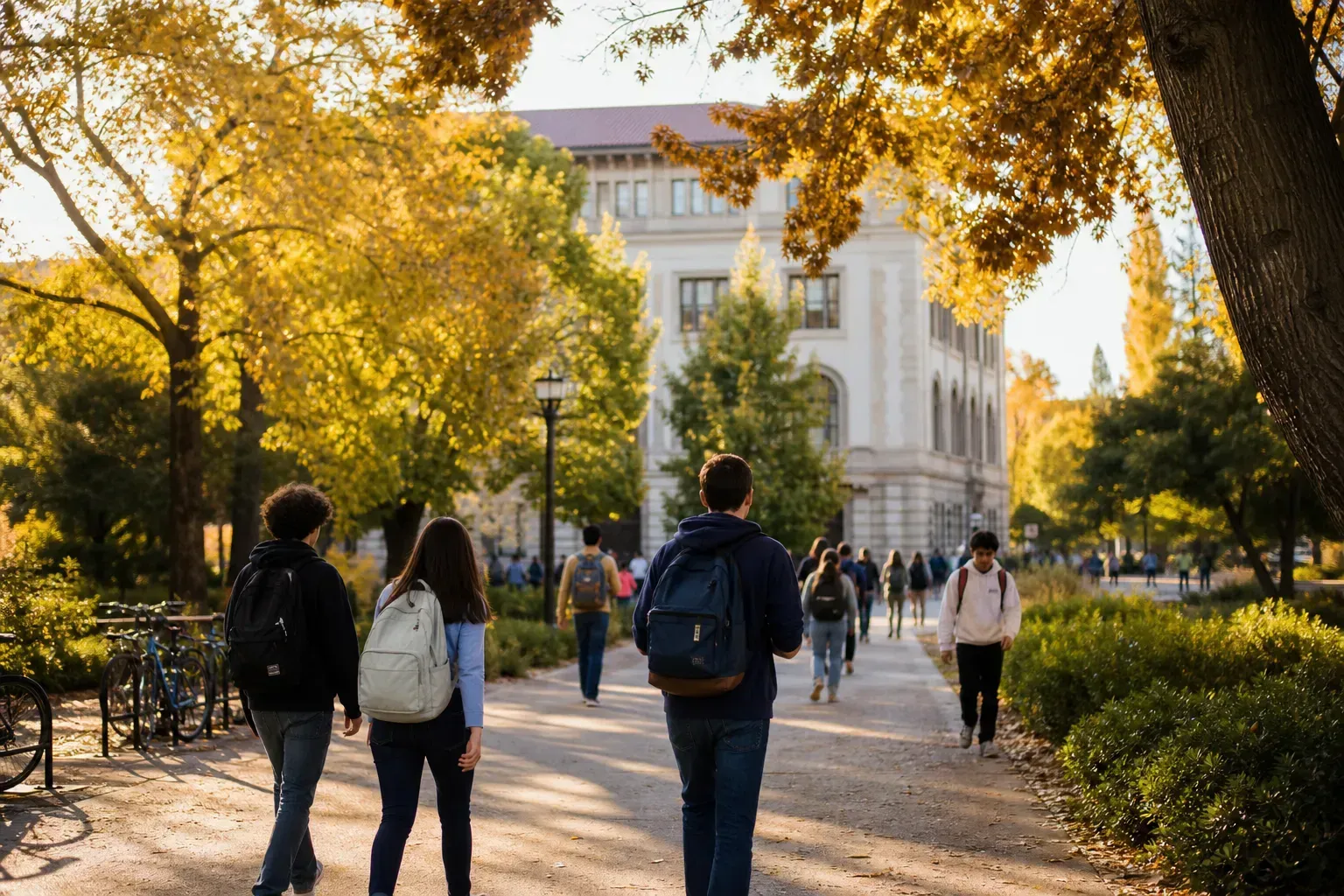
UC Davis: #1 Veterinary Medicine in the U.S., Agricultural Sciences, Winemaking, and the Largest UC Campus
Ranked tied #33 nationally by US News, Top 6 among public universities in the UC system, #1 globally in Veterinary Medicine for 10 consecutive years, Top 3 in the U.S. for Agriculture & Forestry, #1 in the U.S. for Viticulture & Enology, and #1 globally in Entomology, UC Davis is the UC system’s most underrated public flagship, yet world-class in life sciences and agriculture.
UC Davis in one sentence: “America’s agricultural Silicon Valley + California’s life sciences aircraft carrier + the widest and largest campus in the UC system.” It is not a comprehensive academic giant like Berkeley, nor a Hollywood-glow school like UCLA. It is a state agricultural college founded in 1908 to “feed California”, which later evolved into a world-class research center for life sciences, environmental science, and veterinary medicine. To understand UC Davis, start with one point: California is the #1 state in the U.S. for agricultural output, and the science behind California agriculture is UC Davis.
1. Basic Information
| Item | Details |
|---|---|
| Founded | 1908 (originally University Farm) |
| Location | Davis, California (20 minutes west of Sacramento, 1.5 hours northeast of San Francisco) |
| Campus | About 5,300 acres (largest in the UC system and Top 5 largest in the U.S.) |
| Undergraduates | ~31,500 |
| Graduate Students | ~9,000 |
| Student-Faculty Ratio | 1:20 |
| Motto | Fiat Lux (Let there be light, shared across the UC system) |
2. Global Rankings
| Ranking | Position |
|---|---|
| US News National Universities 2025 | #33 |
| QS World 2025 | #129 |
| THE World 2025 | #71 |
| US News Public Universities | #6 |
| Veterinary Medicine (QS World) | #1 (global, 10 consecutive years) |
| Agriculture & Forestry (QS) | Top 3 (U.S.) |
| Viticulture & Enology | #1 (U.S., only independent degree of its kind) |
| Entomology | #1 (global) |
| Plant Sciences | Top 3 (global) |
| Animal Science | Top 3 |
| Environmental Sciences | Top 10 |
UC Davis’s core competitiveness lies in life sciences + agriculture + environment. In this field, it stands alongside Cornell and Wageningen in the Netherlands as one of the three strongest institutions in the world. Its School of Veterinary Medicine has ranked #1 globally for 10 consecutive years, making it a pilgrimage destination for veterinarians worldwide. Viticulture & Enology is a UC Davis specialty, and 60% of winemakers in California’s Napa Valley are UC Davis alumni.
3. Admissions Data (Class of 2028)
| Metric | Value |
|---|---|
| Applicants | ~94,500 |
| Admitted Students | ~35,000 |
| Overall Acceptance Rate | About 37% |
| In-State (CA) Acceptance Rate | About 42% |
| OOS Acceptance Rate | About 38% |
| International Acceptance Rate | About 22% |
| Yield Rate | ~22% |
UC Davis has one of the more accessible acceptance rates in the UC system (alongside UC Riverside and UC Merced). A 37% overall acceptance rate may look friendly, but admission to individual popular majors can be extremely competitive: CS, Animal Science (pre-Vet), and Biological Sciences can approach UCSD-level selectivity.
UC applications use the UC Application system (UC App, deadline 11/30). There is no ED / EA, no recommendation letters, and applicants submit 4 Personal Insight Questions (PIQs). UC Davis is especially friendly to In-State students from California public schools.
SAT/ACT Middle Range
| Test | 25th percentile | Median | 75th percentile |
|---|---|---|---|
| SAT | 1230 | 1370 | 1480 |
| ACT | 27 | 31 | 34 |
The UC system is fully Test-Free for the 2025 application cycle. SAT/ACT scores are not accepted and not evaluated. Standardized test scores are used only for course placement reference.
International Students
- International students make up about 13% of the student body
- Students come from 100+ countries
- More than 1,800 students are from China
- Around 25-40 students from Taiwan are admitted each year
- Animal Science / Viticulture are the most competitive fields for international students (globally unique top-tier programs)
4. Tuition and Financial Aid
2024-2025 Tuition
| Item | Amount |
|---|---|
| In-State Tuition | USD $14,700 |
| OOS / International Tuition | USD $46,400 |
| Housing | USD $17,000 |
| Food | USD $7,200 |
| Personal + Misc | USD $4,500 |
| In-State Total | USD $43,500+ |
| OOS / International Total | USD $75,500+ |
UC Davis’s OOS tuition is the same as UCLA and UCSD (standardized across the UC system), but housing is USD $5K-8K/year cheaper than UCLA / UCSD. Davis is a college town, and rent is far lower than in Los Angeles or San Diego.
Need-Based Aid
- Blue & Gold Opportunity Plan: California resident families with annual income < $80,000 receive full tuition coverage (California residents only)
- Middle Class Scholarship: partial tuition support for California resident families with annual income < $217,000 (California residents only)
- International admissions are Need-Aware, and aid is extremely limited
- Regents’ Scholarship: UC Davis’s most prestigious campuswide scholarship (USD $7,500/year), including priority course registration and research funding; international students may apply
- Average Aid: USD $20,000/year (California residents)
UC Davis is very generous to California residents. OOS / international students should evaluate it as a full-pay option.
5. Academic Structure / Signature Programs
Main Undergraduate Colleges
- College of Letters and Science: the largest college, including CS, Econ, Psych, and English
- College of Agricultural and Environmental Sciences (CA&ES): UC Davis’s flagship college, including Animal Science, Viticulture, and Plant Science
- College of Biological Sciences: Bio, Neurobiology, Microbiology, and Genetics
- College of Engineering: CS, ECE, ME, Aerospace, and Biomedical
- School of Education: undergraduate minor + graduate majors
Signature Programs
- Veterinary Medicine (DVM): a graduate degree, but UC Davis offers a Pre-Vet Animal Science undergraduate pathway and is the #1 Pre-Vet school in the U.S.
- Viticulture & Enology: the only top-tier undergraduate wine science program in the U.S.. Students take “wine tasting courses” in the on-campus RMI Wine Sensory Lab, and graduates enter Napa / Sonoma wineries
- Animal Science: divided into multiple tracks, including Pre-Vet, Equine, Aquaculture, and Companion Animal
- Sustainable Agriculture & Food Systems: an integrated degree in sustainable agriculture
- Biotechnology Major: an undergraduate program connected to Genentech and California’s biotech industry
- University Honors Program (UHP): for the top 7% of students campuswide, with independent honors courses + faculty mentors
- Regents’ Scholars Program: the most prestigious honors program across the UC system
General Education Structure
UC Davis uses a GE Pattern: English writing, language, arts and humanities, social sciences, natural sciences, and other 6 major areas + multicultural requirements. It is slightly more flexible than UCLA / UCSD general education.
6. Campus Culture / Institutional Personality
UC Davis’s personality can be summed up in one sentence: “Bicycle culture + relaxed and friendly + an agricultural college with a California hippie spirit.” UC Davis students, who call themselves “Aggies,” are famous for being friendly. Within the UC system, UC Davis is widely seen as having the least anxious and most chill campus culture. Students dress casually, bike to class, go wine tasting in Napa Valley on weekends, and ski at Lake Tahoe.
UC Davis has a “work hard, but not cutthroat” academic culture. It is much more relaxed than UC Berkeley, UCLA, and UCSD. This is a paradise for students who want to do research without being trampled by classmates. But do not misunderstand: its life sciences, veterinary medicine, and agricultural fields are globally competitive. The culture is simply less peer-competitive than at other UC campuses.
Greek Life / Student Organizations
- About 9% of students join a Fraternity / Sorority (a middle-range share within the UC system)
- Greek Life does not dominate campus; agriculture / environment / life sciences clubs are more mainstream
- Signature events: Picnic Day (the largest student-run event in the U.S., held every April, drawing 70,000 people for livestock shows and lab open houses) and Whole Earth Festival (environmental festival)
Sports Culture
- Big West Conference (NCAA Division I)
- Signature sports: Equestrian, Lacrosse, Baseball, and Track & Field
- UC Davis has the largest student equestrian facility in the U.S.. The Equestrian Center houses more than 200 horses
- American football competes in FCS Division; there is no Power 5 sports identity
7. Location / Campus Environment
City Positioning
Davis is a small city in California’s Central Valley (population 70,000), built almost entirely around UC Davis. It was the first Bicycle-Friendly Platinum city in the United States. The city is planned around bicycles: roads have dedicated bike lanes, 95% of students bike to school, and the UC Davis campus is known as “The Bike Capital of America.”
Distance:
- Sacramento (California state capital): 20 minutes by car
- San Francisco: 1.5 hours by car
- Napa Valley (wine country): 1 hour by car
- Lake Tahoe (skiing): 2 hours by car
- Yosemite National Park: 4 hours by car
Davis is one of the safest college towns in the United States, with a very low crime rate. The downside is that there is “not much to do” on weekends unless students go to Sacramento or San Francisco.
Climate
- Winter: 5-15°C, dry and crisp
- Summer: 18-35°C, dry heat (typical Central Valley climate)
- Spring and fall: California’s most comfortable seasons
- Short rainy season, with 260+ sunny days per year
Campus Landmarks
- The Quad: the central campus lawn, where students sunbathe, play frisbee, and picnic
- The Arboretum: a 100-acre campus botanical garden built along Putah Creek, free and open to the public
- UC Davis Veterinary Medical Teaching Hospital: the largest veterinary teaching hospital in the U.S.
- Robert Mondavi Institute for Wine and Food Science: a wine science center with a teaching winery
- Bohart Museum of Entomology: a world-class insect museum with 8 million specimens
- Unitrans: a student-run double-decker bus system (the only student-operated British-style double-decker bus system in the U.S.)
8. Research and Resources
Libraries
- Peter J. Shields Library (main library)
- 4 libraries across campus, with a total collection of 3.6 million volumes
- Carlson Health Sciences Library is one of the leading veterinary medicine libraries in the U.S.
Major Labs / Research Centers
- Robert Mondavi Institute for Wine and Food Science: world-class wine science
- UC Davis Genome Center: a major center for genomics
- MIND Institute: one of the leading U.S. research centers for autism and neurodevelopmental disorders
- Bodega Marine Laboratory: a marine biology field station on the coast at Bodega Bay
- Tahoe Environmental Research Center: located at Lake Tahoe, focused on global alpine lake research
- California National Primate Research Center: primate research center
- UC Davis Center for Watershed Sciences: water resources science
UC Davis is world-class in veterinary medicine, wine science, agriculture, plant breeding, sustainability, and neuroscience. It is a core research partner university for the USDA, the California Department of Food and Agriculture, and the NIH.
9. Notable Alumni
- Politics / Public Service: Greg Walden (former U.S. Representative), Mike Thompson (U.S. Representative)
- Tech Entrepreneurship: Mike Volpi (Index Ventures GP, former Cisco executive), Steve Wozniak (attended UC Berkeley and briefly audited at UC Davis)
- Life Sciences: Andrea Ghez (2020 Nobel Prize in Physics laureate, formerly taught at UC Davis), Michael Bishop (Nobel Prize in Physiology or Medicine, UCSF/Davis affiliation)
- Agriculture / Food: Robert Mondavi (father of Napa Valley wine, donor behind the Mondavi Institute), Wallace Smith Broecker (climate science pioneer)
- Entertainment / Literature: Yvonne Strahovski (actor, The Handmaid’s Tale), Maya Rudolph (attended, comedian)
- Sports: Kyle Hill (NFL), Mark Aguirre
UC Davis is a global factory for veterinarians, agricultural scientists, and biotech entrepreneurs.
10. Little-Known Facts About UC Davis
- UC Davis is the largest “bicycle campus” in the U.S.: 95% of students bike to school, and the campus has dedicated bike loops, bicycle roundabouts, and bike repair stations. Campus police can issue tickets for riding without a helmet, which would be almost unimaginable on most other U.S. campuses.
- Picnic Day is the largest student-run event in the U.S.: On one Saturday every April, UC Davis opens the campus to the public, including animal demonstrations at the veterinary hospital, lab open houses, student bands, and horse shows. It draws 70,000 people in a single day. It began in 1909 and has been running for 115 years.
- UC Davis keeps the largest number of teaching animals in the U.S.: including 20,000 cattle, 5,000 sheep, 200 horses, and 1,200 chickens. Students take part directly in animal care, breeding, and medical work. Pre-Vet students can work with cattle starting in their first year.
- Robert Mondavi donated USD $25M to build the wine science center: Mondavi was the father of the Napa Valley wine revolution. He asked UC Davis to build the world’s first “commercial-grade winery” inside a university, where students make real wine on campus and carry out full quality-control experiments.
- UC Davis has one of the world’s largest insect specimen collections: the Bohart Museum holds 8 million insect specimens, including one of the world’s largest live displays of spiders, scorpions, and crickets, and is free and open to the public.
11. Typical Admitted Student Profile
- Unweighted GPA ~3.85+ (UC weighted GPA 4.15+)
- SAT/ACT not evaluated (UC Test-Free)
- 8-12 AP / Honors courses (biology / chemistry / environmental science are valued)
- Spike for Pre-Vet: animal internships, farm volunteering, veterinary clinic internships, 4-H Club
- Spike for Viticulture: wine / food science competitions, chemistry research, hands-on food and beverage experience
- Spike for Engineering: FIRST Robotics, hackathons, research publications
- Essays (PIQs) should show genuine passion for nature / animals / sustainability. UC Davis values concrete field experience
- The UC App has no recommendation letters, so the story depends entirely on the PIQs
UC Davis is the UC campus that most values authentic interest in life sciences. Empty statements like “I love animals” will be filtered out. Applicants need concrete animal / agriculture / environmental experience.
12. What Kind of Student Is a Good Fit?
✓ Good fit:
- Students who want Pre-Vet / Animal Science / wine science (this is the #1 school in the world for these fields)
- Students with clear passion for Agriculture, Plant Science, or Environmental Science
- Students who want the UC brand without the competitive pressure of UCLA / UCSD
- Students who like small-town bicycle culture and outdoor activities (Tahoe, Napa)
- Students whose budget allows USD $75K/year (OOS / international students)
- Students who want to do life sciences research and later enter medical school / veterinary school
✗ Not necessarily a good fit:
- Students who want intense urban life (Davis is a small town, and weekends are quiet)
- Students expecting a Top 5 CS / Engineering program (UC Davis CS is Top 50, not Top 10)
- Students who want a Greek Life-dominated party culture
- Students who need Need-Blind aid as international applicants
- Students who want Power 5 American football sports culture
- Students who dislike the dry heat of Central Valley summers
Conclusion
Among Top 35 universities, UC Davis is the most underrated by Taiwanese families, yet world-class in specific fields. It is not Berkeley and it is not UCLA, but its veterinary medicine has ranked #1 globally for 10 consecutive years, its wine science is unique in the U.S., its entomology is #1 globally, and its agriculture is Top 3 in the U.S. If your direction is one of these fields, UC Davis is the best choice on earth. There is no close substitute.
If you are a student who wants to pursue life sciences, environmental science, veterinary medicine, agriculture, or food science, UC Davis offers things Berkeley and UCLA cannot: real fields, real animals, real wineries, and real farms. Its Pre-Vet students do hands-on work in the veterinary hospital starting in their first year, and Viticulture students begin blending wine in the on-campus winery in their second year. UCLA cannot offer that kind of hands-on experience.
The most concrete advice for Taiwanese families: UC Davis has the highest ROI within the UC system for students with clear goals. If you want Pre-Vet → U.S. veterinarian, Viticulture → Napa winery, Animal Science → California ranching, UC Davis is a direct pathway. If you simply want to “attend a UC” without a specific preference, UC Irvine or UCSD may provide a steadier academic fit.
But the harshest fact for Taiwanese families: UC Davis has a very distinct “personality.” It began as an agricultural college, has a relaxed academic culture, is a bicycle campus, and Picnic Day includes cattle demonstrations. This is not a school for students who want an LAC-like refined campus or a Manhattan-style urban campus. If you long for Berkeley’s intellectual tension or UCLA’s Hollywood glow, UC Davis may disappoint you. But if what you want to do is exactly what UC Davis is famous for, it has no rival on earth. That is the clearest way for Taiwanese families to judge UC Davis.
Further Reading
Where does this school belong on your list?
Whether a school is a reach, a match or a safety depends on your transcript, your scores and how that school actually admits international applicants. In one free consultation we place it inside a complete reach/match/safety list rather than judging it on its own.
More in This Topic
UIUC University of Illinois Urbana-Champaign: Top 5 CS, Top 6 Engineering, #1 Accounting, a Tech Giant in the Cornfields
UIUC is a Midwestern public flagship that can go head-to-head with elite private universities on both coasts in STEM, with Top 5 CS, Top 6 Engineering, and #1 Accounting.
Boston College: Carroll School of Management, Jesuit Tradition, and a Gothic Chestnut Hill Campus
A complete guide to Boston College, covering its Jesuit tradition, Carroll School of Management, admissions strategy, campus culture, costs, aid, location, and fit for Taiwanese families.
Tufts University: Fletcher International Relations, Engineering with Liberal Arts, and a “Near-Ivy” in Suburban Boston
Tufts is a small elite private university that is quirkier than the Ivy League, more research-oriented than a liberal arts college, and stronger in engineering than Brown. It is a top choice for students drawn to IR, public policy, pre-med, biomedical engineering, and intellectually distinctive campus culture.
UW Madison, University of Wisconsin-Madison: Big Ten Flagship, No. 1 Sociology, Engineering, and a Lakeside Campus
UW Madison combines the Wisconsin Idea, Big Ten campus life, top-ranked Sociology, Top 15 Engineering and CS, and one of America’s most beautiful lakeside public university campuses.