
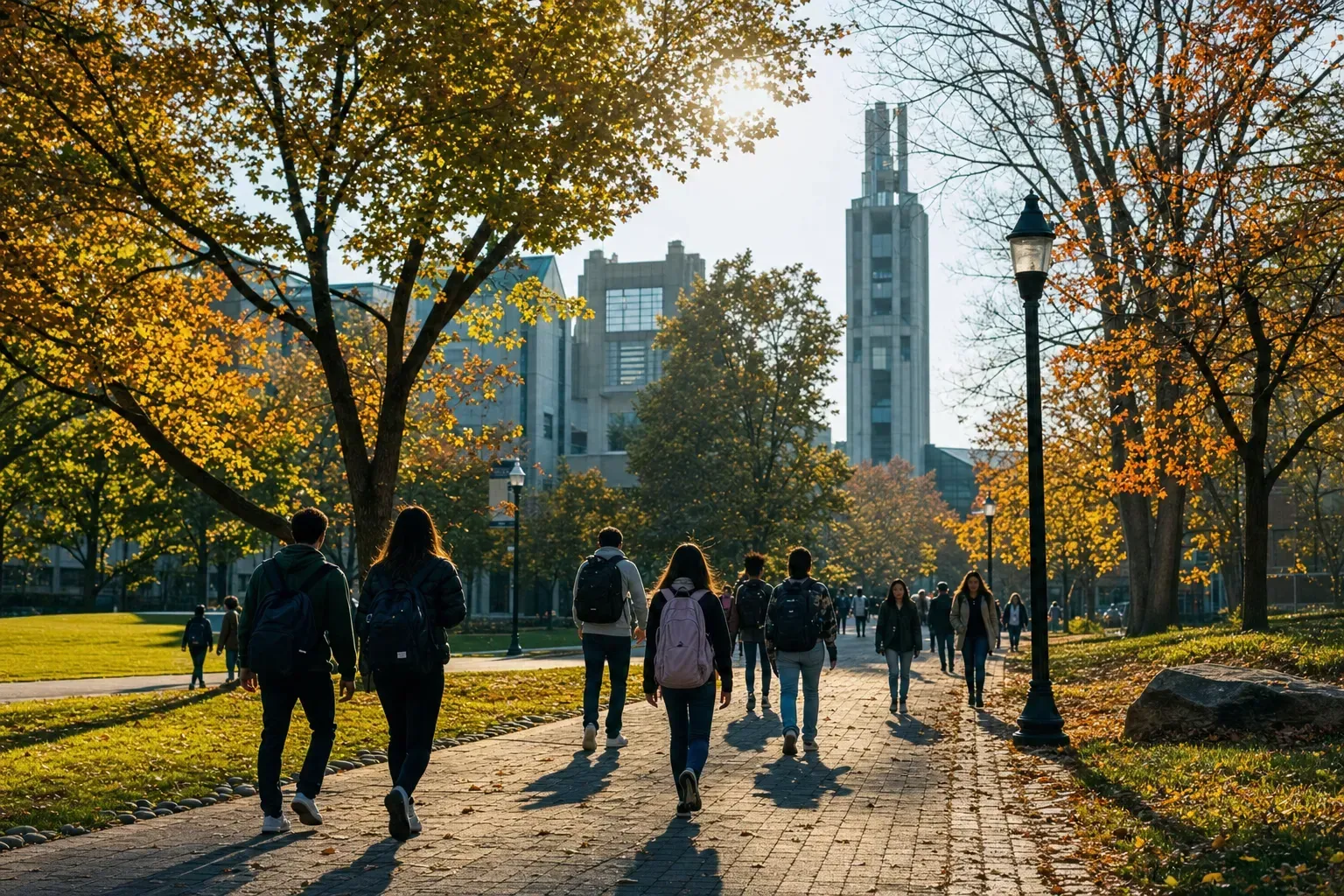
Stony Brook University: Top Physics, Simons Center, Math, Brookhaven, and 30%+ Asian Students
Ranked tied #58 among National Universities by US News, #33 among Public Universities, Top 15 in Physics, home to the world-class Simons Center for Geometry and Physics, Top 25 in Mathematics, Top 50 in Computer Science, Top 50 in Engineering, with a full Health Sciences ecosystem covering Pharmacy, Dental Medicine, and Medicine, a member of the Association of American Universities, about 17,500 undergraduates, and 30%+ Asian students - Stony Brook University is one of the four major research flagships in the State University of New York (SUNY) system and the leading public research university on Long Island, New York. It is seriously underestimated by outsiders, yet in physics and mathematics, parts of its strength can be compared with Caltech and MIT.
In one sentence, Stony Brook is: “Long Island’s temple of physics and mathematics, with the world-class Simons Center for Geometry & Physics, Brookhaven National Lab next door, Top 25 Math, 30%+ Asian students, and a 17,500-undergraduate SUNY flagship environment.” Stony Brook is not an Ivy giant like Cornell, and it is not an urban private university like NYU - it is “founded in 1957, one of SUNY’s four major research flagships, located in central Long Island, and world-class in physics and mathematics.” To understand Stony Brook, first understand one thing: its relationship with Brookhaven National Lab, a U.S. Department of Energy national laboratory located 5 miles from campus, is one of the deepest university-national laboratory partnerships in the United States - Stony Brook physics and engineering students can conduct nuclear physics, particle physics, and light source research at Brookhaven - a close-range national lab experience that Cornell and NYU cannot offer in the same way.
1. Basic Information
| Item | Details |
|---|---|
| Founded | 1957 (established during the 1957 expansion of the SUNY system) |
| Location | Stony Brook, New York (North Shore, central Long Island, New York) |
| Campus | About 1,454 acres (campus + Brookhaven National Lab 5 miles away) |
| Undergraduates | ~17,500 |
| Graduate Students | ~9,000 |
| Student-Faculty Ratio | 1:18 |
| Motto | No formal Latin motto - SUNY emphasizes “Far Beyond” and a spirit of research excellence |
2. World Rankings
| Ranking | Placement |
|---|---|
| US News National Universities 2025 | #58 |
| QS World 2025 | #382 |
| THE World 2025 | #176 |
| US News Public Universities | #33 |
| AAU Member | Yes (the only one in the SUNY system) |
| Physics (Undergrad) | Top 15 |
| Mathematics | Top 25 |
| Geometry / Topology (Simons Center) | World-class |
| Computer Science | Top 50 |
| Engineering (Overall) | Top 50 |
| Materials Engineering | Top 30 |
| Biomedical Engineering | Top 50 |
| Health Sciences (Medical School + Pharmacy + Dental) | Comprehensive |
| Marine Science | Top 25 |
| Linguistics | Top 25 |
| Music | Top 50 |
| School of Journalism | Top 30 |
| Business (College of Business) | Top 100 |
Stony Brook is nationally elite in Physics, Mathematics, Geometry/Topology, Materials, Marine Science, and Linguistics. Physics is Top 15 in the United States - the Simons Center for Geometry and Physics is world-class - a pilgrimage site for theoretical physics, string theory, and mathematical physics. Mathematics is Top 25 - Stony Brook’s math department is powered by the dual engines of the C.N. Yang Institute for Theoretical Physics and the Simons Center. Materials Engineering is Top 30, with close collaboration with Brookhaven National Lab. Marine Science is Top 25, supported by field research on both the north and south shores of Long Island.
3. Admissions Data (Class of 2028)
| Metric | Value |
|---|---|
| Applicants | ~50,000 |
| Admitted Students | ~24,500 |
| Overall Acceptance Rate | About 49% |
| In-State (NY) Acceptance Rate | About 55% |
| OOS / International Acceptance Rate | About 35% |
| EA Acceptance Rate | ~52% |
| Yield Rate | ~21% |
Stony Brook is a more accessible flagship within SUNY - its 49% overall acceptance rate is much more forgiving than Cornell or NYU. Acceptance rates are lower for individual popular programs: CS is around 25-35%, Engineering around 35-40%, Honors College around 15-20%, and Pre-Med BS-MD direct-entry programs around 5-10%.
Stony Brook uses EA + RD - no ED. EA, with a November 1 deadline, is the best strategy for Taiwanese families.
SAT/ACT Median Scores
| Test | 25th percentile | Median | 75th percentile |
|---|---|---|---|
| SAT | 1310 | 1430 | 1500 |
| ACT | 28 | 32 | 34 |
Stony Brook is Test-Optional - scores are not required. However, CS, Engineering, Honors College, and Pre-Med applicants are advised to submit scores.
International Students
- International students make up about 14%
- Students come from 100+ countries
- More than 1,500 students from China
- More than 600 students from India
- More than 300 students from Korea
- About 8-15 students from Taiwan are admitted each year
- Asian students, including international and domestic students, make up ~30%+ - the highest Asian share in SUNY and among the top 10 nationally
4. Tuition and Financial Aid
2024-2025 Tuition
| Item | Amount |
|---|---|
| In-State Tuition | USD $7,070 |
| OOS Tuition | USD $26,500 |
| International Student Tuition | USD $26,500 |
| Housing | USD $10,000 |
| Food | USD $7,000 |
| Personal + Misc | USD $4,500 |
| In-State Total | USD $28,600+ |
| OOS / International Total | USD $48,000+ |
Stony Brook’s USD $48K total cost for OOS / international students is extremely cost-effective among New York public universities and U.S. Top 60 schools - about USD $43K+ per year cheaper than NYU, Cornell, and Columbia. Stony Brook’s in-state tuition of USD $7,070 per year is among the lowest in the SUNY public system.
Need-Based Aid + Merit Aid
- Need-Aware for international students - financial need affects admission chances
- U.S. citizens and permanent residents: meets ~70% of demonstrated need
- Presidential Scholarship: USD $15,000-25,000/year
- Honors College Scholarship: additional support for Honors students
- WISE Honors Program for Women: honors program for women in STEM
- University Scholarship: USD $5,000-10,000/year
- Excellence Scholarship: USD $4,000-8,000/year
- Tuition Excellence Award: USD $5,000/year
- Empire Diversity Scholarship: for underrepresented students
- Brookhaven National Lab apprenticeship opportunities: paid summer internships
- Merit aid for international students is more limited
- Average aid for domestic students: USD $13,000/year
Stony Brook’s Presidential Scholarship of USD $15K-25K per year is friendly to international students. Paid summer internships at Brookhaven National Lab carry strategic value for physics and engineering students - Brookhaven offers summer internship stipends of USD $6,000-10,000. With Stony Brook’s USD $48K OOS total cost plus merit aid, the real annual cost can fall below USD $35K - highly cost-effective for Taiwanese families.
5. Academic Structure / Signature Programs
Main Undergraduate Schools
- College of Arts and Sciences: the largest college, including Physics, Math, CS, Bio, Chemistry, Econ, English, and Linguistics
- College of Engineering and Applied Sciences (CEAS): CS, ECE, ME, Materials, Biomedical, and Civil
- College of Business: Finance, Accounting, Marketing, and Management (weaker, Top 100)
- School of Marine and Atmospheric Sciences (SoMAS): marine science and atmospheric science (marine field stations on both the north and south shores of Long Island)
- School of Journalism: journalism + media
- School of Health Professions: physical therapy and nursing
- School of Nursing
- School of Dental Medicine
- School of Medicine (Renaissance School of Medicine)
- School of Pharmacy
- School of Social Welfare
Signature Programs
- Physics + Simons Center for Geometry and Physics: Top 15 in the United States + world-class - the Simons Center was established in 2008 with a USD $60M donation from James Simons, founder of Renaissance Technologies, billionaire, and former chair of Stony Brook’s mathematics department - a global pilgrimage site for theoretical physics and mathematical physics
- Mathematics: Top 25 in the United States - the C.N. Yang Institute for Theoretical Physics is at Stony Brook - 1957 Nobel Prize in Physics laureate C.N. Yang taught there from 1966 to 1999
- Honors College: ~200 students/year - the university’s most selective honors program + full tuition possibilities, with limited availability for international students
- WISE Honors Program for Women in Science and Engineering: honors program for women in STEM
- University Scholars Program: honors curriculum + independent research funding
- BS-MD Combined Program (Scholars for Medicine): 8-year direct pathway from undergraduate study to medical school - extremely competitive, ~10 students/year
- BS-DDS Combined Program: 8-year direct pathway from undergraduate study to dental school
- Brookhaven National Lab Summer Internships: paid internships for physics, engineering, and materials students, USD $6K-10K per summer
- Long Island High Technology Incubator on Stony Brook’s campus: business incubator
General Education Structure
Stony Brook uses the Stony Brook Curriculum (SBC): English writing, mathematics, natural sciences, social sciences, humanities, arts, culture, interdisciplinary areas, and more - the shared SUNY core framework.
6. Campus Culture / School Personality
Stony Brook’s personality can be summarized in one sentence: “Asian-dense, STEM-heavy in physics and mathematics, suburban Long Island, internationally diverse, and academically introverted.” Stony Brook students, who call themselves “Seawolves,” are known for an “Asian-dense (30%+), STEM academic, New York, international, introverted nerdy” profile - politically moderate, with Asian students at 30%+ (#1 in SUNY and top 10 nationally), white students around 35%, Hispanic students around 12%, international students at 14%, and many students from the New York metropolitan area and international backgrounds.
Stony Brook’s academic culture is “hardworking and academic” - more accessible than Cornell or NYU, but more introverted and much more serious than an average SUNY campus. This is a paradise for students who want Physics / Math / Pre-Med, a New York suburban location, a dense Asian student body, and a very reasonable budget. Princeton Review has repeatedly recognized Stony Brook for “Best Career Services,” “Best Schools for Physics,” and “Best Value.”
Greek Life / Student Clubs
- About 5% of students participate in fraternities / sororities (extremely low - an Asian-dense and STEM-academic campus culture weakens Greek Life)
- Academic clubs, cultural clubs, physics and math clubs, Korean / Chinese / Indian student associations, and medical-school-oriented Pre-Med clubs replace Greek Life as the center of campus social life
- Signature events: Roth Pond Regatta (a spring “cardboard boat race” - students build cardboard boats and cross Roth Pond - the campus’s most distinctive tradition), Welcome Week, International Festival, Strawberry Fest, Earthstock Earth Day
- 350+ student clubs
Athletics Culture
- America East Conference + Coastal Athletic Association (CAA football) (NCAA Division I, but athletics are not the core culture)
- Signature sports: men’s soccer, women’s basketball, men’s basketball, track and field
- Stony Brook Stadium: football home field, capacity 12,300
- Island Federal Arena: basketball home court
- Wolfie mascot - a wolf
- Stony Brook athletics are not the center of campus culture - students care more about academics, research, and Pre-Med
7. Location / Campus Environment
City Positioning
Stony Brook is located in Stony Brook - on the North Shore of central Long Island, New York (population 15,000; Suffolk County, Long Island, population 1.5 million). Stony Brook is an “upscale residential area in central Long Island” - 60 miles / 1.5 hours by LIRR train from Manhattan - 1.5 hours by car from JFK Airport - 5 miles from Brookhaven National Lab.
Distance:
- Manhattan, New York City: 1.5 hours by LIRR train (Stony Brook LIRR station is next to campus)
- JFK International Airport: 1.5 hours by car
- LaGuardia Airport: 1.5 hours by car
- Brookhaven National Lab: 5 miles / 10 minutes by car
- Long Island beaches (Smith Point Beach, Robert Moses State Park): 30 minutes by car
- The Hamptons (New York’s elite beach resort area): 1.5 hours by car
Stony Brook’s campus is a “large suburban Long Island campus” - surrounded by upscale residential neighborhoods and woods - a 5-minute walk from campus to the LIRR station with direct access to Manhattan - 5 miles from Brookhaven National Lab and 30 minutes from Long Island beaches - this combination of “public university + New York suburbs + next to Brookhaven National Lab” is rare in the United States.
Climate
- Winter: -3 to 5°C, frequent snow
- Summer: 18-28°C, comfortable
- Spring and fall: New York’s most beautiful seasons
- Winters are snowy but not endless
Campus Landmarks
- Frank Melville Memorial Library (Main Library): main library
- Charles B. Wang Center: Asian cultural center - built with a donation from Charles Wang, founder of Computer Associates and a billionaire - the core of Asian cultural activities on campus
- Simons Center for Geometry and Physics: campus landmark - research center for theoretical physics and mathematical physics
- Roth Pond: central campus pond - site of the Roth Pond Regatta cardboard boat race
- Staller Center for the Arts: performing arts venue
- Sports Complex / Stony Brook Stadium
- Island Federal Arena: basketball home court
- HSC (Health Sciences Center): medical school + dental school + nursing + pharmacy
- C.N. Yang Institute for Theoretical Physics
8. Research and Resources
Libraries
- Frank Melville Memorial Library (main library)
- 5 libraries across campus, with a total collection of 2.2 million volumes
Major Laboratories / Research Centers
- Brookhaven National Laboratory (BNL): U.S. Department of Energy national laboratory (5 miles from campus) - jointly managed by Stony Brook and Battelle - includes the Relativistic Heavy Ion Collider (RHIC) and National Synchrotron Light Source II (NSLS-II) - the largest X-ray synchrotron light source in the United States - paid internships for Stony Brook physics and engineering students
- Simons Center for Geometry and Physics: theoretical physics + string theory + mathematical physics (established in 2008 with a USD $60M donation from James Simons)
- C.N. Yang Institute for Theoretical Physics: founded in 1966 by 1957 Nobel Prize in Physics laureate C.N. Yang
- Center for Functional Nanomaterials (CFN, Brookhaven)
- Long Island Center of Excellence in Wireless and Information Technology
- School of Marine and Atmospheric Sciences (SoMAS) research stations: marine field research on both the north and south shores of Long Island
- Renaissance School of Medicine + Stony Brook Medicine health system
Stony Brook is world-class in theoretical physics, string theory, mathematical physics, nuclear physics through Brookhaven RHIC, X-ray synchrotron research, marine science, Materials Engineering, and biomedical science. Brookhaven National Lab + Simons Center + C.N. Yang Institute form the three major research networks behind Stony Brook’s global standing in physics and mathematics. RHIC, the Relativistic Heavy Ion Collider, is one of the world’s few top heavy-ion colliders - Stony Brook physics PhD students and undergraduate honors students can participate in RHIC experiments.
9. Notable Alumni
- Technology / Business: Jerry Yang (Yahoo co-founder and billionaire - born in Taiwan, immigrated to the United States at age 10 in 1968, briefly attended Stony Brook before transferring to Stanford - often connected to Stony Brook’s broader cultural roots), Charles Wang (Computer Associates co-founder, former owner of the New York Islanders NHL team, and billionaire - Stony Brook Mathematics 1967 - namesake of the Charles B. Wang Center), Jim Simons (founder of Renaissance Technologies, billionaire, and chair of Stony Brook’s mathematics department from 1968 to 1976 - donated USD $60M to establish the Simons Center for Geometry and Physics and later gave billions of dollars to Stony Brook)
- Academia / Nobel Prizes: C.N. Yang (1957 Nobel Prize in Physics laureate for parity nonconservation - Stony Brook physics professor from 1966 to 1999 - founder of the C.N. Yang Institute for Theoretical Physics), Paul Lauterbur (2003 Nobel Prize in Physiology or Medicine laureate and inventor of MRI - Stony Brook chemistry professor from 1969 to 1985), Robert Aumann (2005 Nobel Prize in Economic Sciences laureate - former visiting scholar at Stony Brook)
- Politics: Patty Murray (U.S. Senator from Washington - Stony Brook Education 1972)
- Performing Arts / Media: Joe Iconis (Broadway composer), Kevin James (comedian, King of Queens and Mall Cop - Stony Brook sports, 1987-1990), Jorge Posada (former New York Yankees baseball player - Stony Brook baseball)
- Mathematics: John Milnor (Fields Medal 1962 + Abel Prize 2011 - Stony Brook mathematics professor), John Pardon (Fields Medal candidate - former Stony Brook professor)
Stony Brook’s alumni and faculty networks have deep influence in theoretical physics through C.N. Yang, quantitative finance through Renaissance Technologies and James Simons, Silicon Valley technology through Jerry Yang and Charles Wang, and mathematics through Milnor. C.N. Yang and Paul Lauterbur, two Nobel laureates, taught at Stony Brook - a rare concentration for a public university. James Simons is Stony Brook’s enduring benefactor - a former mathematics chair, founder of Renaissance Technologies, billionaire, and donor of billions of dollars to Stony Brook. The Charles Wang Center, an Asian cultural center, is a hub of Asian student activity on campus. Jerry Yang’s Stony Brook connection, as the Taiwan-born co-founder of Yahoo, has special meaning for Taiwanese families.
10. Stony Brook Facts Few People Know
- Stony Brook is 5 miles from Brookhaven National Lab and jointly manages it: Brookhaven National Laboratory (BNL) is a U.S. Department of Energy national laboratory - 5 miles from Stony Brook’s campus - Stony Brook and Battelle jointly manage BNL - BNL includes the Relativistic Heavy Ion Collider (RHIC, one of the world’s few top heavy-ion colliders) and the National Synchrotron Light Source II (NSLS-II, the largest X-ray synchrotron light source in the United States) - Stony Brook physics / engineering / materials students can complete paid summer internships and PhD dissertation research at BNL - this is the “next to a national lab” advantage that Cornell, NYU, and Columbia cannot offer in the same way - only about six U.S. universities have this level of deep collaboration with a national laboratory, including Stony Brook, Caltech-JPL, UChicago-Argonne, and Berkeley-LBL.
- C.N. Yang taught at Stony Brook for 33 years: 1957 Nobel Prize in Physics laureate C.N. Yang moved from the Institute for Advanced Study in Princeton to Stony Brook in 1966 - founded the C.N. Yang Institute for Theoretical Physics - taught there from 1966 to 1999, a total of 33 years - continued his work on parity nonconservation, Yang-Mills Theory, and gauge field theory during his Stony Brook years - returned to Tsinghua University in China after retiring in 1999 - the C.N. Yang Institute remains a global pilgrimage site for theoretical physics. For Taiwanese families, “Stony Brook = C.N. Yang’s school” is one of the most strategically meaningful associations - Taiwan’s physics community has deep ties to Stony Brook.
- The Simons Center was established with James Simons’ USD $60M donation: James Simons, founder of Renaissance Technologies, the godfather of quantitative finance, and a billionaire, chaired Stony Brook’s mathematics department from 1968 to 1976 - left academia for finance and founded Renaissance Technologies, one of the most profitable hedge funds in the world - net worth USD $30B+ - donated USD $60M to Stony Brook in 2008 to establish the Simons Center for Geometry and Physics - then continued donating billions of dollars to Stony Brook - Simons is Stony Brook’s enduring benefactor - the Simons Foundation is also one of the largest private funders of mathematics and physics research in the United States - this connection gives Stony Brook’s mathematical physics research a level of private funding that even Stanford and Princeton would envy.
- Stony Brook’s Asian student population is 30%+ - #1 in SUNY: Asian students at Stony Brook, including international and domestic students, make up 30%+ - #1 in SUNY and top 10 nationally - this share reflects Stony Brook’s appeal to Asian families: STEM-heavy, world-class physics and mathematics, New York suburban location, reasonable public tuition, and a Pre-Med pipeline - the campus has the Charles B. Wang Center Asian cultural center, active Chinese student associations, Taiwanese student groups, Korean student groups, and Indian student groups - for Taiwanese families, Stony Brook belongs in the same tier as the most Asian-dense major U.S. universities such as UC Davis, UC Irvine, and Stony Brook - Asian students are unlikely to feel isolated.
- The Roth Pond Regatta cardboard boat race is the campus’s most distinctive tradition: Roth Pond Regatta has been a Stony Brook spring tradition since 1989 - students build boats out of cardboard, tape, and masking tape (no waterproof materials allowed) - then cross Roth Pond on campus - most boats sink halfway through - this is a playful expression of Stony Brook STEM students’ hands-on physics and engineering culture - ESPN has covered it - the tradition has continued for 36 years - every Stony Brook student should see it at least once during four years.
11. Typical Admitted Student Profile
- Unweighted GPA ~3.85+
- SAT 1430+ or ACT 32+ (1500+ for CS / Engineering / Honors / BS-MD applicants)
- 8-12 AP courses (STEM-heavy)
- Spike for Physics / Math: physics competitions (Physics Olympiad), math competitions (AMC, AIME, USAMO), Brookhaven summer internships
- Spike for CS: USACO, hackathons, open-source GitHub
- Spike for Pre-Med / BS-MD: medical volunteering, shadowing, research publications, AMC, USABO
- Spike for Engineering / Materials: FIRST Robotics, research publications, Brookhaven shadowing
- Essays should show “why Stony Brook + the Simons Center / Brookhaven connection + genuine STEM passion” - Stony Brook looks for intellectual depth, STEM motivation, and research passion
- Recommendation letters should tell stories of research ability + intellectual depth + STEM passion
Among public Top 60 universities, Stony Brook is one of the schools that cares most about genuine passion for Physics / Math / Pre-Med and fit with Brookhaven / Simons. Purely bragging essays will be screened out - Stony Brook wants to see “why this student would thrive at the Simons Center for mathematical physics, Brookhaven National Lab, and a 17,500-undergraduate SUNY flagship.”
12. What Kind of Student Is a Good Fit?
✓ Good fit:
- Students who want Physics / Math (world-class Simons Center + C.N. Yang Institute)
- Students who want Pre-Med / BS-MD 8-year direct entry
- Students who want Engineering / Materials (paid Brookhaven internships)
- Students who want a SUNY flagship + New York suburbs + a very reasonable budget (OOS ~USD $48K/year)
- Students comfortable with an Asian-dense campus (30%+)
- Students who want an academic STEM campus (weaker Greek Life, weaker football culture)
- Students who like suburban Long Island + New York City 1.5 hours away by train
✗ Not necessarily a good fit:
- Students who want intense American campus spirit (Stony Brook athletics are weaker)
- Students who want a Greek Life party culture (only 5% of students participate)
- Students who want Ivy prestige (Stony Brook is less famous than Cornell, NYU, and Columbia)
- Students who want a strong pure humanities / pure business environment (Stony Brook is centered on STEM + Health Sciences)
- Students uncomfortable with an “Asian-dense + academically introverted” campus
- Students aiming for a top business school (Stony Brook Business is weaker)
- Students who want small-class LAC education (large 200+ student lectures are common at Stony Brook)
Conclusion
Among public Top 60 universities, Stony Brook is the state university that best fits the profile of “Long Island’s physics and mathematics temple + next to Brookhaven National Lab + Asian-dense SUNY flagship.” It is not an Ivy giant like Cornell or an urban private university like NYU - but its Physics is Top 15 in the United States, Mathematics Top 25, Geometry/Topology world-class through the Simons Center, Materials Engineering Top 30, Marine Science Top 25, CS Top 50, Engineering Top 50, Linguistics Top 25, and Health Sciences comprehensive. It also has Brookhaven National Lab 5 miles away + joint management + paid summer internships, the Simons Center for Geometry and Physics founded through James Simons’ USD $60M donation, the C.N. Yang Institute for Theoretical Physics where C.N. Yang taught for 33 years, Paul Lauterbur’s Nobel-winning MRI legacy, billionaire alumni and benefactors Jerry Yang, Charles Wang, and Jim Simons, AAU membership as the only SUNY member, 30%+ Asian students, and the Roth Pond Regatta cardboard boat race - these details together form “Long Island’s temple of physics and mathematics.”
If you are a student who wants Physics, Mathematics, Pre-Med, or Engineering, especially Materials, and you are drawn to hands-on national laboratory research at Brookhaven National Lab, Stony Brook is one of the few places on earth that can offer “world-class physics and mathematics + a national lab next door + reasonable public tuition” at the same time. Physics students at Stony Brook work alongside top global string theorists at the Simons Center, math students encounter the C.N. Yang Institute’s theoretical physics legacy, and engineering students can conduct particle physics experiments at Brookhaven’s RHIC heavy-ion collider. Brookhaven 5 miles away + joint management + paid summer internships is Stony Brook’s core advantage over Cornell, NYU, and Columbia.
The most concrete advice for Taiwanese families: Stony Brook is one of the best choices for families who want Physics / Math / Pre-Med, a New York suburban location, an Asian-dense student body, and a very reasonable budget. OOS / international total cost of USD $48K/year is USD $43K+/year cheaper than NYU and Cornell - over four years, the difference can exceed USD $170K. The 30%+ Asian student population materially helps Taiwanese students integrate into campus life - the campus has the Charles Wang Center Asian cultural center plus active Chinese / Taiwanese / Korean student associations. Paid internships at Brookhaven National Lab carry high strategic value for STEM students. “C.N. Yang’s school” has special symbolic meaning for Taiwanese physics and engineering families.
But the harshest reality for Taiwanese families: Stony Brook has weaker name recognition in Taiwan - for families outside physics and mathematics, “Stony Brook” may be unfamiliar, and when friends hear “my child attends Stony Brook,” they may not be impressed. Its name recognition is weaker than Cornell, NYU, and Columbia. Stony Brook’s “academically introverted + weaker social scene + weaker athletics” personality means it is not suitable for students who want a lively American campus, Greek Life, and football. Stony Brook is in suburban Long Island; although Manhattan is 1.5 hours away by train, the actual four-year life is still a suburban campus life - students dreaming of “New York City life” may be disappointed - Stony Brook is not NYU. Stony Brook’s Asian-dense environment is a double-edged sword - it helps Taiwanese students integrate, but students seeking a fully American immersion experience may feel as if they are living in an “Asian student dorm”. Stony Brook Business is weaker - students aiming for elite business schools or Wall Street should not choose Stony Brook for that reason alone. If you care about brand prestige, want a lively American campus, want top business school positioning, or want Manhattan urban life, Stony Brook is not a fit. But if you want “world-class Physics + Top 25 Math + Brookhaven national lab + Pre-Med direct pathways + Asian-dense campus + New York suburbs + very reasonable budget + C.N. Yang legacy,” Stony Brook has few rivals anywhere on earth. That is the most concrete way Taiwanese families should evaluate Stony Brook.
Further Reading
Where does this school belong on your list?
Whether a school is a reach, a match or a safety depends on your transcript, your scores and how that school actually admits international applicants. In one free consultation we place it inside a complete reach/match/safety list rather than judging it on its own.
More in This Topic
How to Balance Reach / Match / Safety Schools in U.S. Admissions: The 12-School Golden Formula
The most common trap in U.S. college admissions: submitting 8 Ivies + 2 UCs, then getting rejected everywhere. This article uses a 15-year consulting formula to break down the Reach / Match / Safety ratio and show what the 12-school golden combination should actually look like.
The Golden 12-School Mix of Reach, Safety, and Dream Schools: A Consultant's 15-Year Field-Tested Formula
Parents insist on 8 Ivy schools, the student insists on applying only to Stanford, and the mother tears up asking, "Why apply to Penn State?" In 15 years of admissions consulting, the hardest part has never been data analysis. It is family negotiation. Using one student's real 12-school list, this article shows how dream, reach, and safety schools can all fit at the same table.
Liberal Arts Colleges vs Large Research Universities: The Real Difference Between LACs and Research Universities
Most Taiwanese parents have never heard of Williams, Amherst, or Pomona, but these LACs often outperform the Ivy League in student-faculty ratio, the percentage of courses taught directly by professors, and Med school / PhD recommendation success rates. This article breaks down the real competitiveness of LACs and offers a decision tree for who should choose an LAC and who should choose a Research U.
Which Schools Should You Choose for Business and Management? 10 Key Criteria for Selecting a Top BBA Program
The U.S. BBA Top 10 is not just Wharton. MIT Sloan, Cal Haas, UMich Ross, and UVA McIntire each have distinct strengths, but for international students, OPT/H-1B pathways, IB recruiting, and tuition structures vary enormously. This article uses 10 key criteria to break down which school is right for you.