
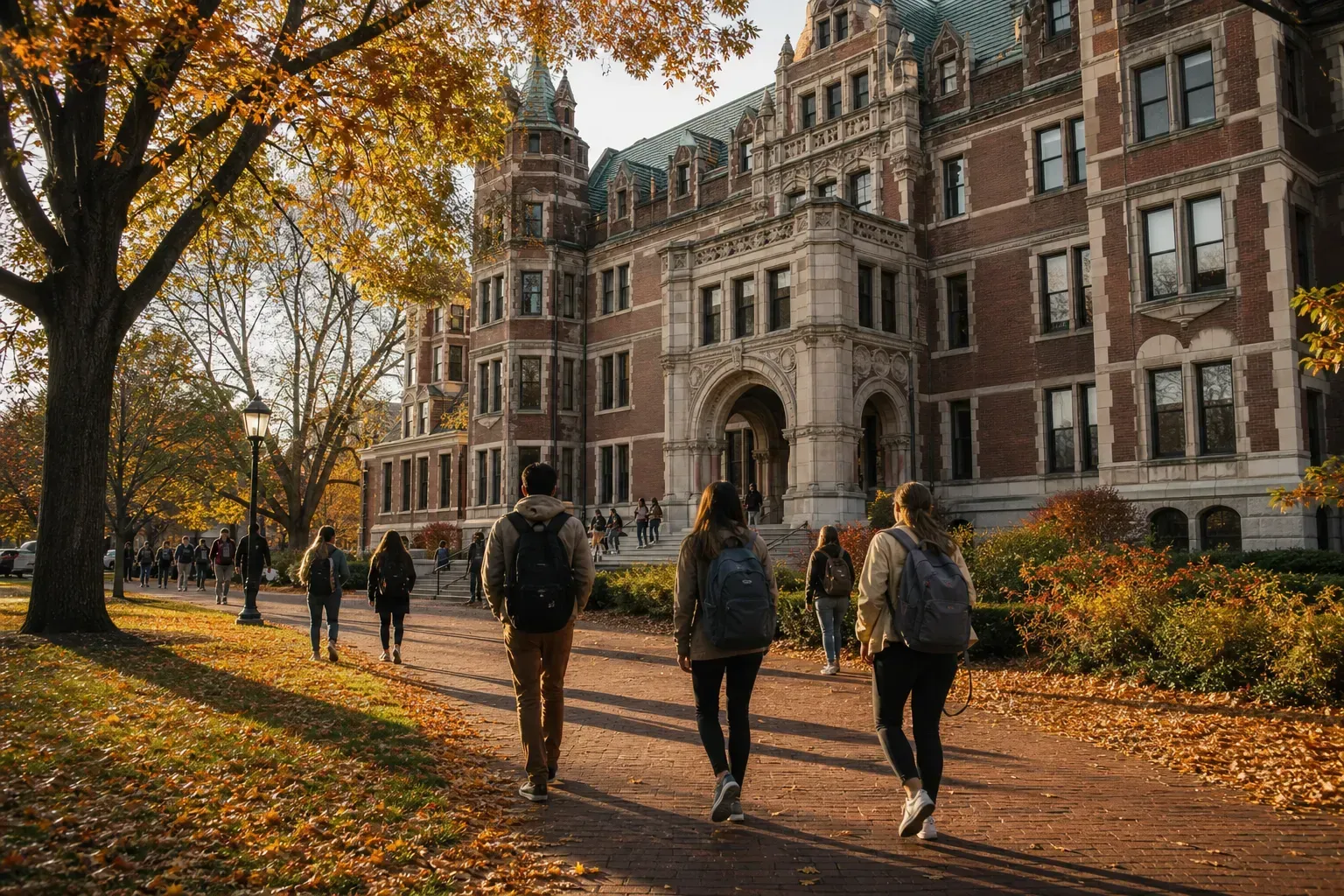
Boston University: COM College of Communication, Questrom School of Business, and the Charles River Urban Campus
Tied at #41 among National Universities in US News, home to a Top 5 College of Communication (COM), a Top 25 Questrom School of Business, a Top 5 Sargent College of Health & Rehabilitation Sciences, and a Top 15 Biomedical Engineering (BME) program, Boston University is Boston’s “most urban, largest, and most international” private research university. Its atmosphere stands in sharp contrast to neighboring BC’s suburban Jesuit character.
Boston University can be summarized in one sentence: “A 1.5-mile urban campus along the Charles River + one of the strongest communication schools in the U.S. + Boston’s most international large private university.” BU is not BC’s small, refined Catholic liberal arts environment, nor Northeastern’s engineering-oriented, Co-op-branded model. It is an urban academic complex stretched along Commonwealth Avenue in Boston: no walls, no front gate, and the Green Line B branch effectively serves as the campus shuttle. To understand BU, start with one point: its “campus” is part of the city of Boston. Students move between Starbucks, Trader Joe’s, Whole Foods, and classes. This is a truly urban university.
1. Basic Information
| Item | Details |
|---|---|
| Founded | 1839, founded by the Methodist Church |
| Location | Boston, Massachusetts, along Commonwealth Avenue in the city center |
| Campus | About 140 acres, a 1.5-mile linear campus along the Charles River |
| Undergraduates | ~18,000 |
| Graduate students | ~16,500 |
| Student-faculty ratio | 1:11 |
| Motto | Learning, Virtue, Piety |
2. World Rankings
| Ranking | Placement |
|---|---|
| US News National Universities 2025 | #41 |
| QS World 2025 | #108 |
| THE World 2025 | #84 |
| College of Communication (COM) | Top 5 in the U.S. |
| Sargent College of Health & Rehabilitation | Top 5, with PT and OT among the nation’s leaders |
| Questrom School of Business (Undergrad) | Top 25 |
| Biomedical Engineering | Top 15 |
| Economics | Top 30 |
| International Relations | Top 25 |
| Film & Television Production (COM) | Top 10 |
| School of Hospitality Administration | Top 10 in the U.S. |
| School of Theology | Top 10 |
BU is one of the few private comprehensive universities that balances a Top 5 communication program, a Top 25 business school, and Top 5 health and rehabilitation programs. COM is one of the temples of communication education in the United States, with alumni including media figures such as Howard Stern, Bill O’Reilly, and Tom Bergeron. Sargent’s Physical Therapy (PT) and Occupational Therapy (OT) graduate programs have ranked in the U.S. Top 5 for years, making them among BU’s most underrated signature strengths.
3. Admissions Data (Class of 2028)
| Metric | Value |
|---|---|
| Applicants | ~80,000 |
| Admitted students | ~8,800 |
| Overall acceptance rate | About 11% |
| ED1 / ED2 acceptance rates | ~25% / ~20% |
| RD acceptance rate | ~9% |
| Yield Rate | ~31% |
BU uses a three-round structure: ED1 + ED2 + RD. There is no EA. Over the past decade, BU’s acceptance rate has fallen from 30% to 11%, one of the steepest drops among private universities in the U.S. With an ED acceptance rate of about 25%, ED is the most strategically valuable option for Taiwanese families. Questrom and COM are more selective than the university overall, with estimated acceptance rates around 8-9%.
SAT/ACT Middle Range
| Test | 25th percentile | Median | 75th percentile |
|---|---|---|---|
| SAT | 1420 | 1490 | 1530 |
| ACT | 32 | 34 | 35 |
BU is Test-Optional, so applicants are not required to submit scores. However, students applying to competitive programs in Questrom or CAS, such as computer science, are advised to submit strong scores.
International Students
- International students make up about 22% of the student body, one of the highest proportions among Top 50 universities
- Students come from 130+ countries
- More than 3,500 students are from China, among the top three totals in the U.S.
- About 30-50 Taiwanese students are admitted each year
- BU is one of the private universities in the U.S. with the largest international student populations, with a particularly large Chinese student community
4. Tuition and Financial Aid
2024-2025 Cost of Attendance
| Item | Amount |
|---|---|
| Tuition | USD $66,670 |
| Housing | USD $12,400 |
| Food | USD $6,600 |
| Personal + Misc | USD $5,000 |
| Total | USD $90,700+ |
BU’s total cost of about USD $91K is comparable to urban private universities such as NYU, USC, and Tufts, and about USD $4-5K per year lower than Harvard, MIT, and BC.
Need-Based Aid
- Need-Aware for international students, meaning financial need can affect admission chances
- U.S. citizens and permanent residents: Need-Blind + meets 100% of demonstrated need since 2023
- Trustee Scholarship: BU’s most prestigious university-wide scholarship, covering full tuition; about 20 students per year; international students may apply
- Presidential Scholarship: Merit Aid, USD $25,000 per year
- Dean’s Scholarship: USD $10,000-20,000 per year; international students may apply
- About 47% of students receive Need-Based Aid
- Average aid: USD $48,000 per year
BU’s aid policy is more flexible for international students than BC’s. International students can receive Merit Scholarships such as Trustee, Presidential, and Dean’s awards, which is a key reason BU can be more friendly than BC for Taiwanese families.
5. Academic Structure / Signature Programs
Main Undergraduate Schools/Colleges
- College of Arts & Sciences (CAS): The largest college, including CS, Bio, Econ, Psych, and IR
- Questrom School of Business: Undergraduate business, including Finance, Accounting, Marketing, and Operations
- College of Communication (COM): Journalism, Film/TV, PR, Advertising, and Communication Studies
- College of Engineering: BME, ECE, ME, CivilE, and Aerospace
- Sargent College of Health & Rehabilitation Sciences: Health Science, PT, OT, and Speech-Language
- College of Fine Arts (CFA): Music, Theater, and Visual Arts
- School of Hospitality Administration: Hospitality management, Top 10 in the U.S.
- Wheelock College of Education & Human Development
Signature Programs
- COM Film & TV: Top 10 in the U.S. Students produce short films, documentaries, and television programs within four years, with graduates entering Hollywood and New York media
- COM Journalism: BU alumni include NBC, CBS, and ABC anchors, making it one of New England’s strongest communication degrees
- Questrom Honors Program: Business school honors, including BU Sustainability Innovation
- Sargent Health Science → DPT/OTD: Integrated undergraduate-to-graduate pathways; entering Sargent’s PT/OT graduate programs is one of the most popular paths in the U.S.
- Kilachand Honors College: BU’s cross-college honors program, about 100 students per year, including an independent capstone and residential college-style housing
- BU/CFA 7-Year DMD dental pathway: Direct undergraduate-to-dental school pathway
- Questrom HUB (Honors Undergraduate Business): Business school honors track
- BU Study Abroad: One of the largest in the U.S., with 70+ overseas programs and about 70% of students studying abroad during their time at BU
General Education Structure
BU uses the BU Hub: six cross-disciplinary capacities, including Philosophical, Aesthetic & Historical Inquiry; Scientific & Social Inquiry; Quantitative Reasoning; Diversity, Civic Engagement & Global Citizenship; Communication; and Intellectual Toolkit. It is much more flexible than BC’s Jesuit Core. The BU Hub emphasizes “capacities” rather than fixed “themes.”
6. Campus Culture / Institutional Personality
BU’s personality can be summed up as: “urban, international, practical, fast-paced, and unmistakably Boston.” BU students, who call themselves “Terriers,” are known for their urban sensibility, international diversity, and action-oriented mindset. Compared with BC’s prep culture, Tufts’ intellectual quirkiness, and Northeastern’s Co-op engineering orientation, BU feels more pragmatic. Student style ranges from Patagonia to streetwear, and the diversity far exceeds BC’s.
BU’s academic culture is hardworking but not excessively cutthroat. It is more relaxed than BC and Tufts, but more serious than UMass Amherst. This is a haven for students who want Boston without Ivy-style anxiety. Princeton Review has repeatedly recognized BU as a “Top Urban University” and for having one of the “Most Diverse Student Body” communities.
Greek Life / Student Organizations
- About 5% of students join a fraternity or sorority, very low and typical of an urban university
- Greek Life does not dominate campus; clubs, cultural organizations, and media groups, such as COM-produced BUTV and WTBU radio, are the mainstream
- Signature activities: Splash, the opening-week club fair; BU Beach, a spring picnic tradition on the Marsh Plaza lawn; and Lobster Night, the annual lobster dinner
- 800+ student organizations, one of the most diverse club ecosystems in New England
Sports Culture
- Patriot League, D1 but no football
- Signature sports: men’s hockey, men’s basketball, crew, and soccer
- Agganis Arena is the home venue for hockey and basketball
- BU has no football team, which was discontinued in 1997, one of the biggest differences between BU and BC
- Beanpot Tournament: The annual February hockey tournament at TD Garden featuring BU, BC, Harvard, and Northeastern; BU has won the most titles
- Charles River rowing: BU shares the Charles River rowing tradition with Harvard and MIT, and the annual Head of the Charles is the world’s largest rowing event
7. Location / Campus Environment
Urban Positioning
BU is located on Commonwealth Avenue, commonly called “Comm Ave”: a 1.5-mile linear campus between Back Bay and Allston on the western side of central Boston. BU has no real concept of a walled campus. The “green T tracks” of the Green Line B branch run through the middle of campus, and students cross streets, watch traffic lights, and navigate bikes between classes.
Distance:
- Boston Common downtown: 15 minutes by subway
- Fenway Park, home of the Red Sox: 15 minutes on foot
- Newbury Street, boutique shopping street: 10 minutes on foot
- Back Bay: 10 minutes on foot
- Cambridge / Harvard / MIT: 25 minutes by subway
- Logan Airport: 30 minutes by car
BU and BC are “same-city twins,” but BU is truly urban while BC is suburban. BU students spend all four years immersed in real Boston city life: grocery shopping at Star Market, coffee at Pavement, weekends on Newbury Street, and a 15-minute walk to TD Garden for Bruins games. This is the real version of “the city is the campus.”
Climate
- Winter: -5 to 5°C, frequent snow, and a frozen Charles River
- Summer: 18-28°C and humid
- Fall: New England’s most beautiful season, with red maples
- Winter is long, and warmth usually does not arrive until April
Campus Landmarks
- Marsh Plaza: The heart of BU’s campus, including Marsh Chapel and the MLK Jr. statue; Martin Luther King Jr. earned his PhD at BU
- Mugar Library: Main library, open 24 hours
- CAS Building: Main building of the College of Arts & Sciences
- Questrom School of Business: Business school building
- Photonics Center: Research center for photonics
- BU Beach: Lawn beside Marsh Plaza, a spring picnic favorite
- The Castle: The BU president’s residence, a Gothic-style mansion
- Charles River Esplanade: Riverside jogging and rowing area along campus
- Agganis Arena: Home venue for hockey and basketball
8. Research and Resources
Libraries
- Mugar Memorial Library, the main library
- Pardee Management Library, for Questrom
- Pickering Educational Resources Library, for education
- 8 libraries across campus, with 2.8 million total volumes
Notable Labs / Research Centers
- National Emerging Infectious Diseases Laboratories (NEIDL): One of only 12 BSL-4 biosafety laboratories in the U.S., on the same biosafety level as USAMRIID and the CDC
- Photonics Center: A global leader in photonics research
- Howard Hughes Medical Institute Research
- Center for Antiracist Research: Founded by Ibram X. Kendi
- Institute for Sustainable Energy
- Hariri Institute for Computing
- Center for the Study of Asia
BU’s research strengths are in biomedicine, infectious diseases, photonics, neuroscience, and communication research. It is a core university partner for the NIH and the U.S. Department of Defense. MLK Jr. earned his PhD in systematic theology from BU in 1955, a permanent point of pride for the university.
9. Notable Alumni
- Politics: Martin Luther King Jr., civil rights leader and BU systematic theology PhD 1955; Tipper Gore, former Second Lady of the United States; Bill Cohen, former U.S. Secretary of Defense; Edward Brooke, the first popularly elected Black U.S. senator
- Media / Communication: Howard Stern, radio legend and COM alumnus; Bill O’Reilly, former Fox News anchor; Tom Bergeron, host of Dancing with the Stars; Mika Brzezinski, MSNBC anchor; Faye Wattleton
- Performing Arts / Film: Geena Davis, Oscar-winning actress; Marisa Tomei, Oscar-winning actress; Julianne Moore, Oscar-winning actress and former BU student; Rosie O’Donnell; Jason Alexander of Seinfeld
- Technology / Business: Bill Rasmussen, founder of ESPN; Christine Lagarde, former IMF president and former BU faculty member
- Sports: Tony Massarotti, sports journalist; Cam Neely, NHL Hall of Famer
- Academia / Nobel Prizes: BU alumni and faculty include 9 Nobel laureates, including Sheldon Glashow, Physics 1979, and Elie Wiesel, Peace 1986 and BU professor
BU’s alumni network has deep influence in U.S. media, Hollywood, Boston finance, and international organizations. Three Oscar-winning actresses, Davis, Tomei, and Moore, came from BU, a density rarely seen anywhere in the U.S.
10. Boston University Facts You May Not Know
- Martin Luther King Jr. earned his PhD at BU: In 1955, MLK received his doctorate in systematic theology from BU. His dissertation was titled A Comparison of the Conceptions of God in the Thinking of Paul Tillich and Henry Nelson Wieman. The MLK statue, “Free at Last,” on Marsh Plaza is the campus’s most sacred landmark, and an annual MLK Day commemoration is held there every January.
- BU has one of the “longest campuses” in the U.S.: The campus runs 1.5 miles along Commonwealth Avenue, from Kenmore Square to the BU Bridge. A student who finishes class at BU Central and then needs to reach BU East may walk 15 minutes. The Green Line B branch effectively functions as an internal campus shuttle.
- BU has no football: BU cut its football team in 1997. President John Silber believed football was too expensive and did not fit BU’s urban academic image. BU instead invested in hockey and rowing, and BU men’s hockey has won 5 NCAA national championships, far more than most football schools have achieved in their signature sport.
- NEIDL is one of only 12 BSL-4 laboratories in the U.S.: BU’s National Emerging Infectious Diseases Laboratories can study the most dangerous pathogens, including Ebola, Marburg virus, and SARS. During the 2014 Ebola crisis and the 2020 COVID outbreak, NEIDL was one of the core research centers. The controversy is that the lab sits on the edge of a residential neighborhood in the South End, prompting years of local protest.
- BU’s tuition growth has been among the fastest in the Top 50: In 1980, BU tuition was USD $5,400 per year; by 2025, it was USD $66,670, a twelvefold increase over 45 years. Former president John Silber, who served from 1971 to 1996, was especially aggressive in raising tuition and academic prestige, transforming BU from a “Boston commuter school” into a national Top 50 private university.
11. Typical Admitted Student Profile
- GPA Unweighted ~3.85+
- SAT 1450+ or ACT 33+; Questrom and CAS CS applicants should aim for 1500+
- 8-12 AP courses, depending on academic direction
- Spike for COM: school newspaper, radio, video production, Pulitzer Centerpiece, debate, Model UN
- Spike for Questrom: business competitions, entrepreneurial projects, simulated investing, finance internships
- Spike for Sargent: medical volunteering, PT/OT shadowing, research publications
- Spike for Engineering: FIRST Robotics, Hackathon, research publications
- Essays should show “why Boston + why BU’s urban campus fit”; BU looks for the “whole person” and urban adaptability
- Recommendation letters should tell stories of leadership + international perspective + hands-on execution
Among Top 50 universities, BU is one of the schools that cares most about urban adaptability + international diversity fit. Pure bragging essays tend to fail. BU wants to see why this student would thrive on the Comm Ave urban campus.
12. What Kind of Student Is a Good Fit?
✓ Good fit for students who:
- Want Boston and want a truly urban environment, not BC’s suburb
- Have a clear direction in COM communication, film/TV, or Journalism
- Want Questrom business plus internationally diverse peers
- Are interested in Sargent PT/OT/Health Science
- Like a highly diverse international peer group, with 22% international students
- Want a city experience with tuition slightly lower than NYU
- Can afford USD $91K per year
✗ Not necessarily a good fit for students who:
- Want a traditional walled campus + football party atmosphere; BU has no football and no enclosed campus
- Have little patience for city noise and commuting
- Want a party culture dominated by Greek Life
- Expect a STEM Top 10 environment; BU CS and Engineering are Top 30-50, not Top 10
- Want small-class LAC-style education; BU is primarily a large-class university
- Are concerned about a campus with a dense international population, including 3,500+ students from China
Conclusion
Among Top 50 universities, Boston University is the representative of “Boston’s most urban, most international, and most practical” private education. It is not BC’s small, refined Catholic liberal arts college, not Tufts’ intellectually driven university culture, and not Northeastern’s Co-op engineering model. But its COM is Top 5 in the U.S., Sargent PT/OT is Top 5, Questrom is Top 25, and Biomedical Engineering is Top 15. It also offers a 1.5-mile urban campus along the Charles River, real Boston city life, a diverse 22% international student community, and the historical prestige of being MLK’s PhD alma mater. Together, these details make BU “Boston’s most urban private university.”
If you are a student who wants Boston + wants a true city environment + wants the COM/Questrom/Sargent brand names, BU is one of the few choices on earth that can satisfy all three conditions at once. Its communication graduates enter NBC, CBS, and Hollywood; its PT/OT graduate programs are recognized in global health-care circles; and Questrom has a firm foothold in Boston finance.
The most concrete advice for Taiwanese families: BU is one of the best choices for families who want Boston, do not want BC’s Catholic culture, do not want Northeastern’s required Co-op identity, and can afford USD $91K. BU’s 22% international student population means Taiwanese students will not feel alone. But it also means the 3,500+ Chinese student community may make some students feel as if they are in a “Chinese student dormitory in Boston” rather than on an American campus.
But the harshest reality for Taiwanese families: BU’s campus-less urban identity is a real test. It has no walls, no quad, no BC-style Gothic aesthetic, and no football tailgate scene. Students who dream of a traditional American campus may be disappointed. BU is also a massive private university: 18,000 undergraduates spread along Commonwealth Ave in Boston, and students can easily feel small. If you want “small and refined + American campus + professors who know you,” BC and Tufts are better fits. But if you want “urban reality + international diversity + COM/Questrom/Sargent brand strength + slightly lower cost,” BU has no real competitor in Boston. This is the clearest judgment BU offers Taiwanese families.
Further Reading
Where does this school belong on your list?
Whether a school is a reach, a match or a safety depends on your transcript, your scores and how that school actually admits international applicants. In one free consultation we place it inside a complete reach/match/safety list rather than judging it on its own.
More in This Topic
Ohio State University: Big Ten Giant, Fisher College of Business, Buckeyes Football, Engineering
Ohio State is a Top 50 public flagship with one of the largest undergraduate populations in the U.S., strong Fisher Business, Engineering, Logistics, Welding Engineering, Veterinary Medicine, Pharmacy, and an unmatched Big Ten football culture.
Rutgers University-New Brunswick: New Jersey Flagship, Top 5 Pharmacy, Math Powerhouse, and Big Ten
Rutgers combines Big Ten scale, New Jersey flagship status, Top 5 Pharmacy, elite discrete mathematics, New York access, and one of the strongest value propositions among East Coast public universities.
UMD University of Maryland, College Park: CS Top 15, Engineering, Smith Business, and a State Flagship Next to DC
University of Maryland, College Park is a Big Ten public flagship with CS Top 15, Aerospace Top 10, Smith Business Top 25, and unmatched access to DC, NASA, NSA, and federal policy internships.
University of Rochester: Eastman Music Ranked No. 1, Optics Ranked No. 1, Open Curriculum
University of Rochester is one of the most academically independent and underrated mid-sized private universities in Upstate New York, known for Eastman, Optics, Brain & Cognitive Sciences, and its Open Curriculum.